
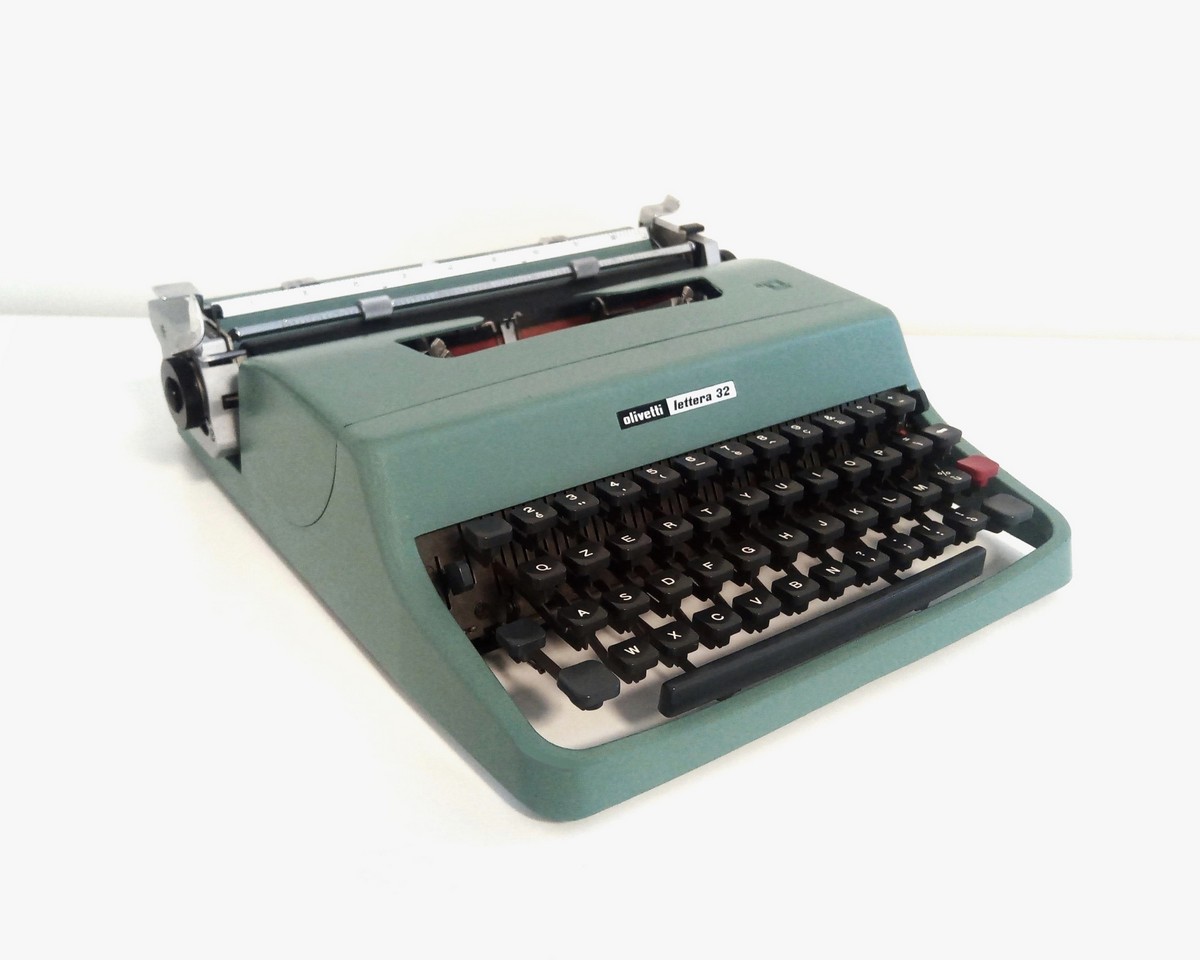


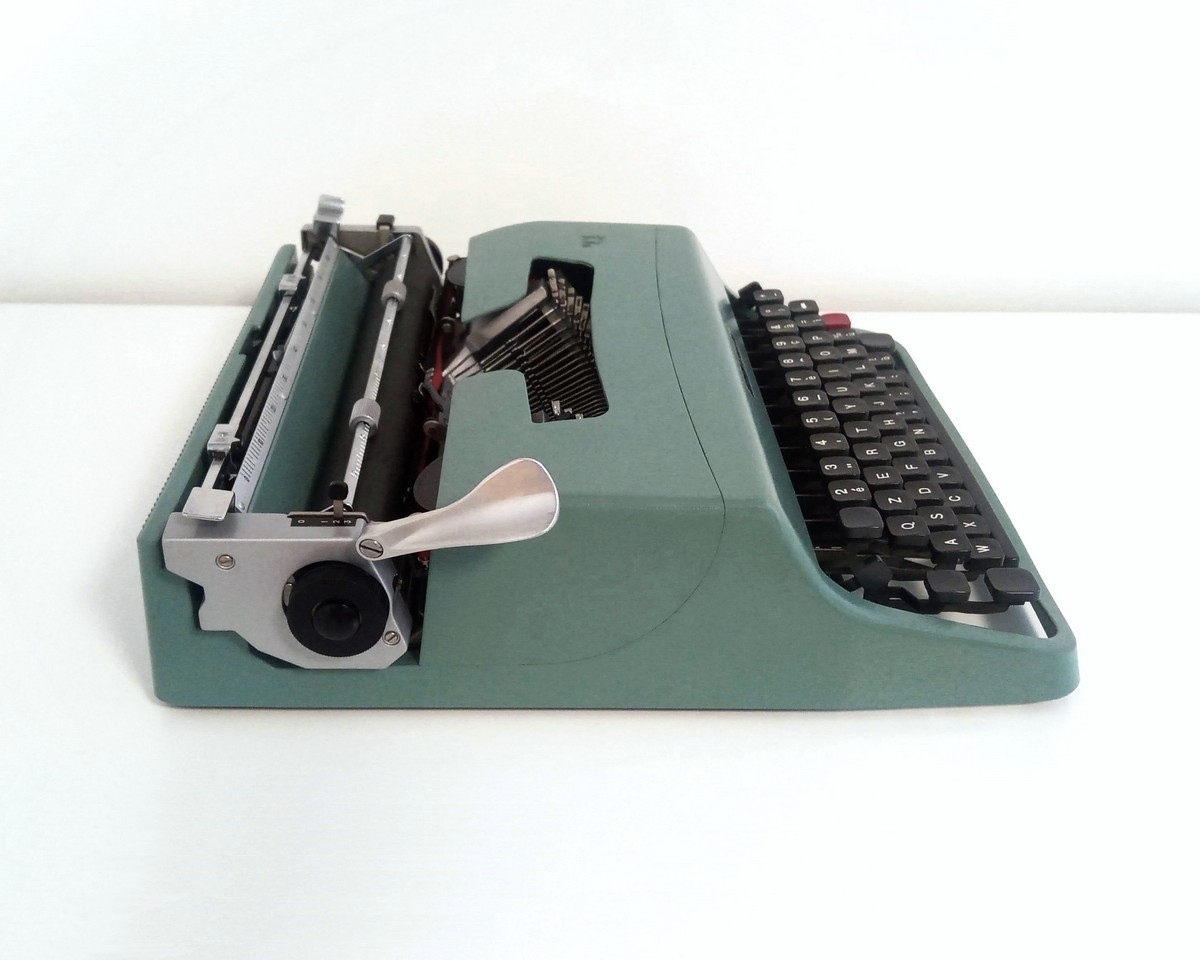




Olivetti Lettera 32 is a typewriter I always work on with great passion. It was, in fact, the first model I ever bought, and it reminds me of my early, tentative attempts at restoration at the age of fourteen. How many thoughts, how many poems I wrote with it—small joys of adolescence!
Designed by Marcello Nizzoli as a successor to the Lettera 22, the Lettera 32 is a highly successful typewriter that quickly became very popular worldwide.
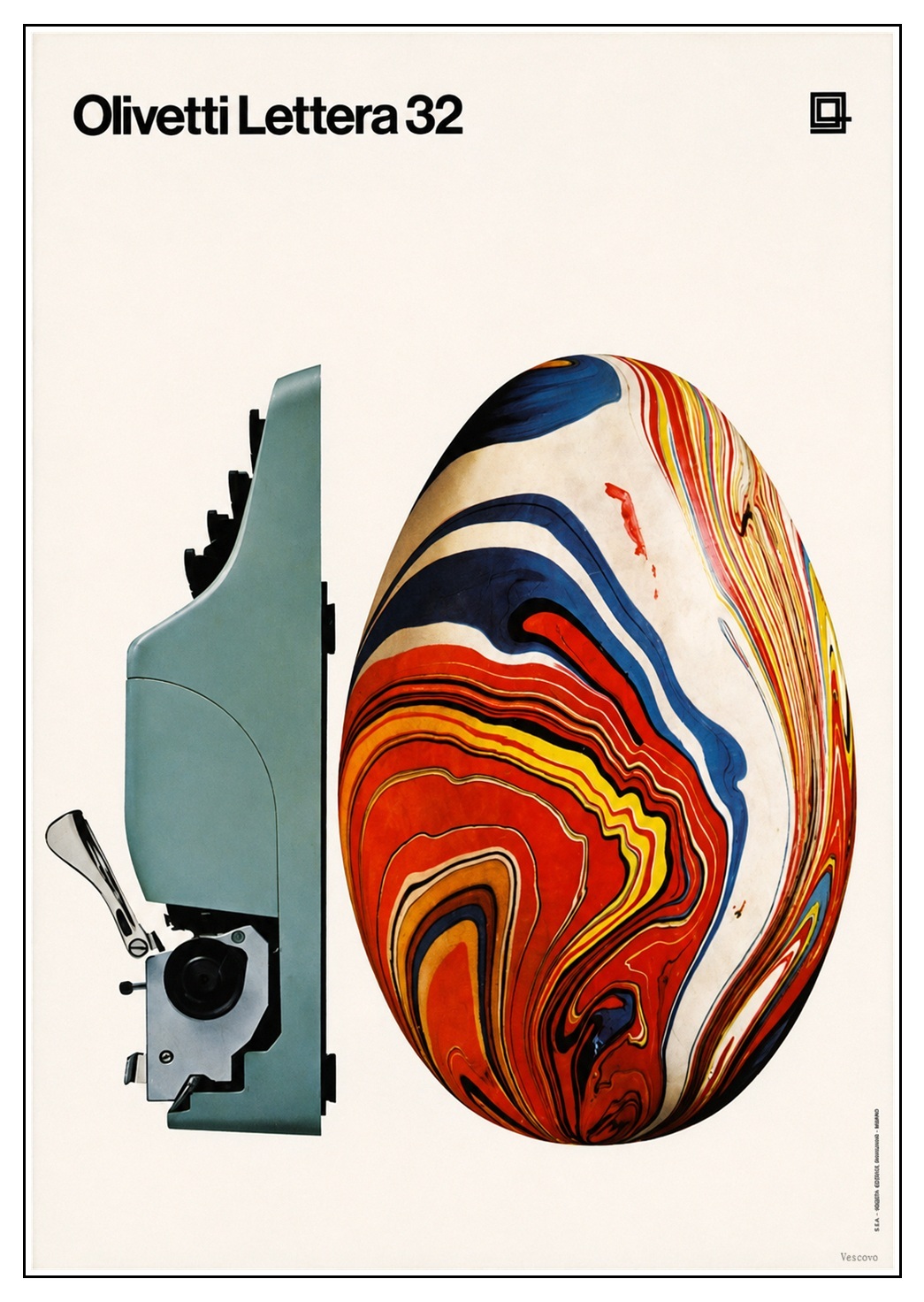
The outer casing consists of two die-cast aluminum parts. The main section forms the machine's perimeter and is secured to the mechanical body at four points, while a secondary section is attached by a snap-fit mechanism. Removing it provides easy access for cleaning the type slugs and replacing the ribbon. In terms of dimensions and weight, the Lettera 32 is slightly larger and heavier than its predecessor, measuring 32 × 28 × 9 cm and weighing 4.2 kg. The paint finish, typically green or gray-green, is powder-coated and remarkably durable. The machine body was designed and manufactured almost entirely from stamped sheet metal, with the exception of the typebar basket, which remains a single-piece component made of light alloy. This made it possible to further reduce production costs while maintaining a good level of quality. The mechanics of the Olivetti Lettera 32 would become the basis for all subsequent mechanical Olivetti portable typewriters, including the Lettera 35, the Dora, the famous Valentine, and many others.
The mechanism is smooth and responsive, especially in the "Made in Italy" version produced during the 1960s, which I recommend choosing over later examples manufactured at the Mexican and Yugoslav plants. These machines do not have the same level of finish as those produced in Italy, and it has been observed that the overall typing comfort is also different, even when the machines have undergone the same restoration process and started from similar initial conditions. This is a surprising fact, demonstrating just how much the mechanical precision of each individual component contributes to the overall quality of a typewriter.

A complete restoration of a typewriter begins with the disassembly of the machine, followed by a thorough cleaning of all mechanical components, first using an ultrasonic bath and then rinse using a petroleum-based solvent.
Once cleaned, every component is carefully dried and reassembled, and then the internal mechanism is precisely lubricated to guarantee optimal performance. The mainspring is also dismantled, cleaned, and reassembled with fresh grease, ensuring consistent tension and smooth carriage movement.
The machine then undergoes a comprehensive adjustment process, including fine-tuning of the kinematics, ribbon lift, and upper/lower case alignment. Components subject to natural wear, such as the ink ribbon, rubber grommets, carriage drawcord, and any weakened springs, are replaced with new parts.
Against stubborn dirt dried after fifty or more years of neglect, the classic combination of kerosene and a brush would achieve very little. I am referring specifically to dried correction fluid, eraser residue —sometimes melted by the heat of an attic—, hardened grease, deposits of sebum mixed with dead skin, and so on. The ultrasonic cleaning tank I use in my restorations was built by a specialized company and is specifically designed and custom-made for cleaning typewriters.
How does it work? The phenomenon involved is cavitation. The powerful waves generated by the sonotrodes are transmitted into the water, creating microbubbles at extremely high pressure that implode upon contact with the object. Using a simple solution of water and soap, a combined action is achieved: a physical high-frequency “micro-brushing” effect together with the degreasing action of the detergent dissolved in the bath. The result is excellent, with a low environmental impact when biodegradable soaps are used.

Olivetti Lettera 32 mechanical body after disassembly and ultrasonic cleaning.


To restore an Olivetti Lettera 32 typewriter to perfect working condition, it is essential to rebuild the various rubber components, which over time tend to harden and eventually crumble completely. Feet, main platen, and both lower and front paper rollers—all must be renewed. Everything is made possible thanks to experience and specialized equipment. For more information, please visit this page.


At the end of the restoration, the typewriter undergoes a complete functional test. A final test certificate—typed on the machine itself, signed, and stamped—is issued as proof of successful inspection and completion of the service.
