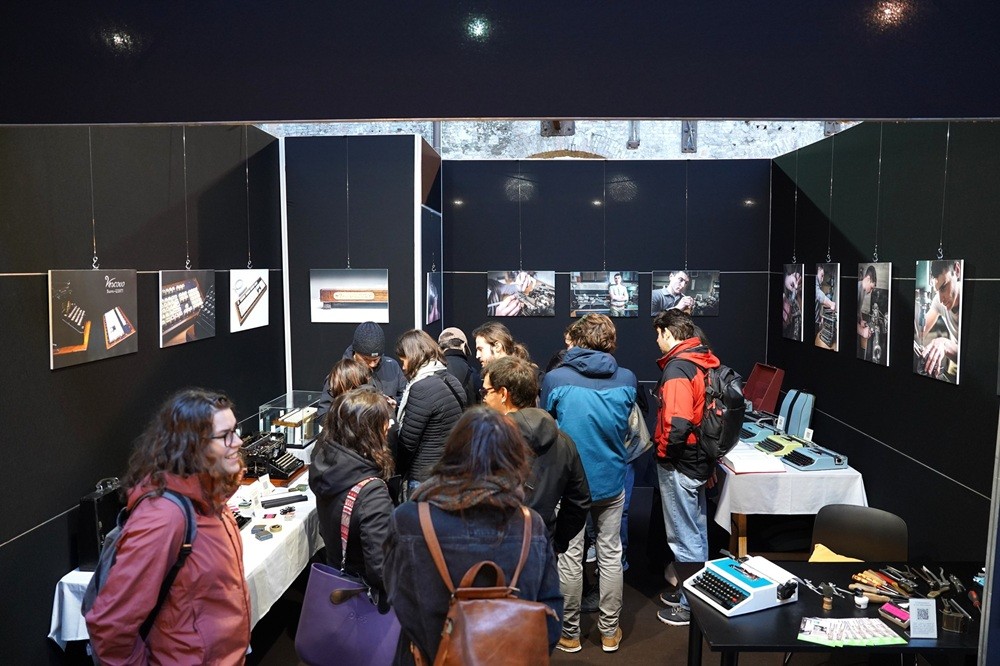
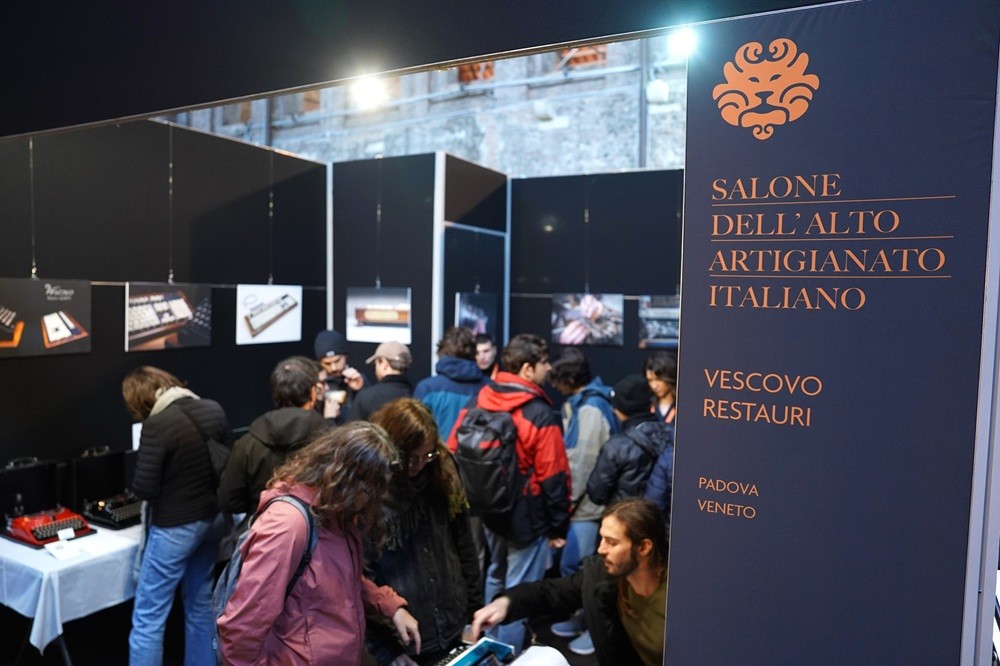
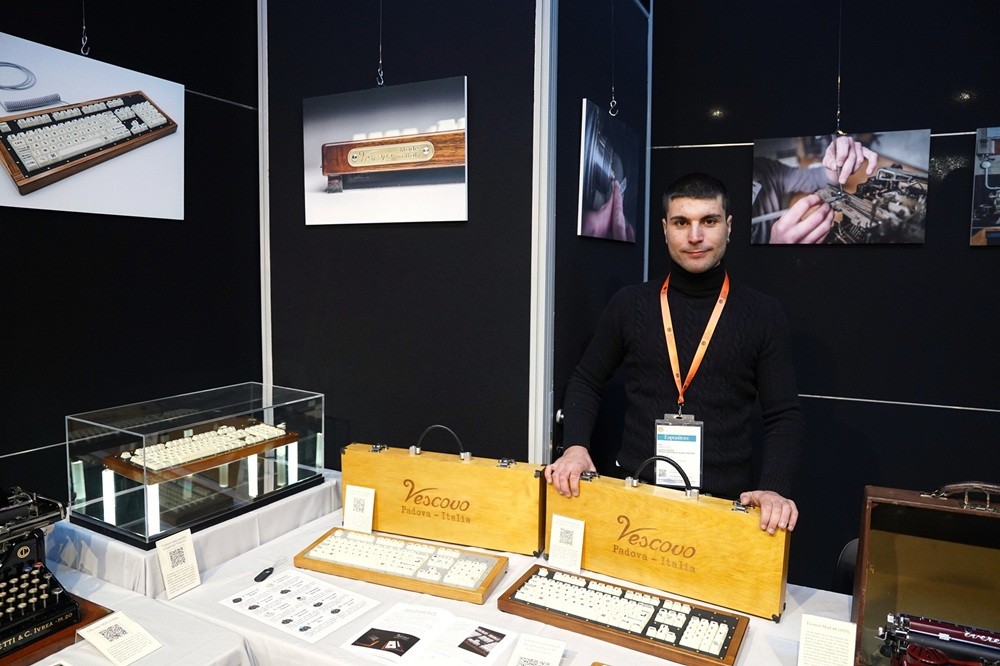
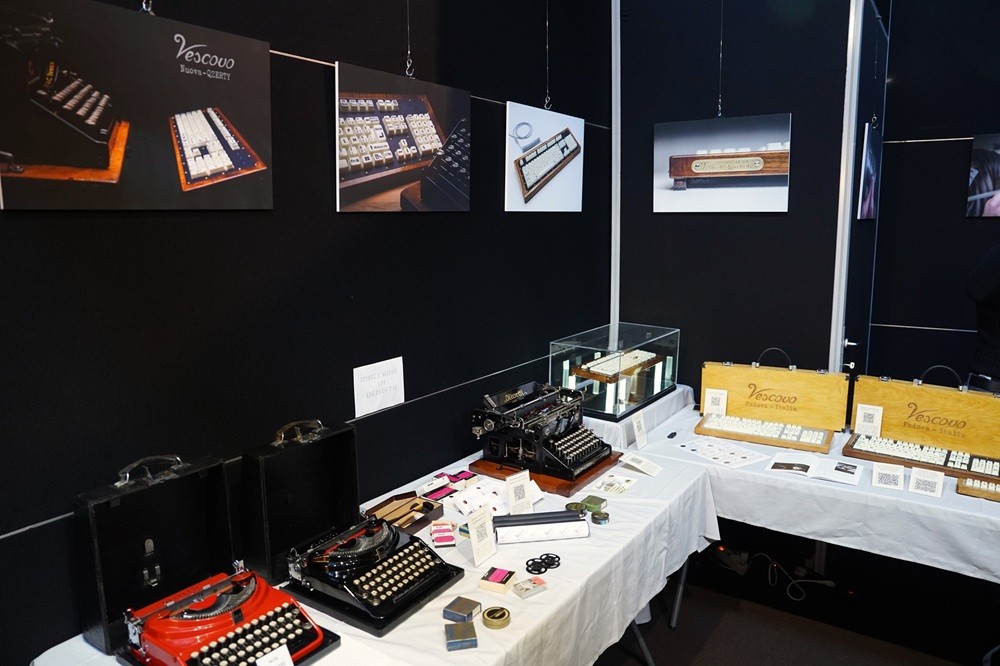
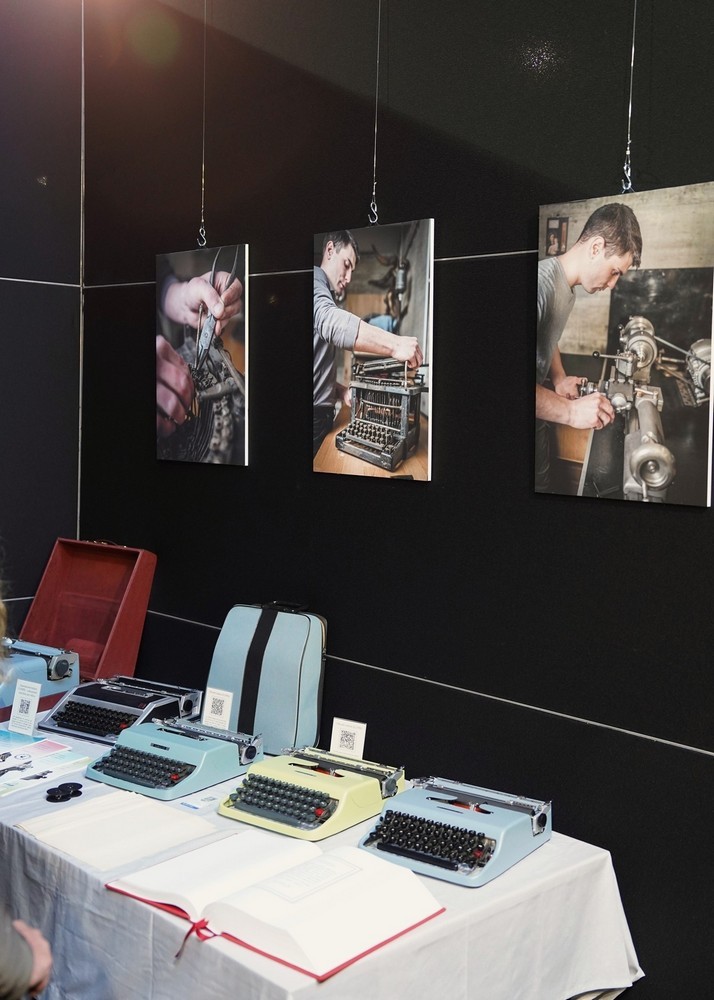
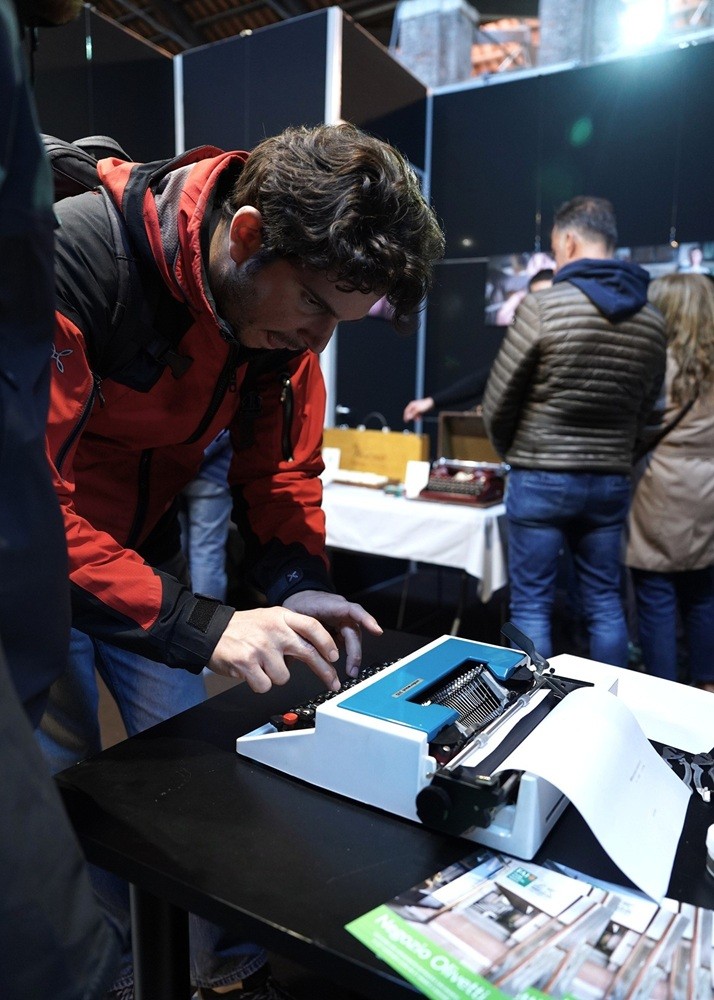
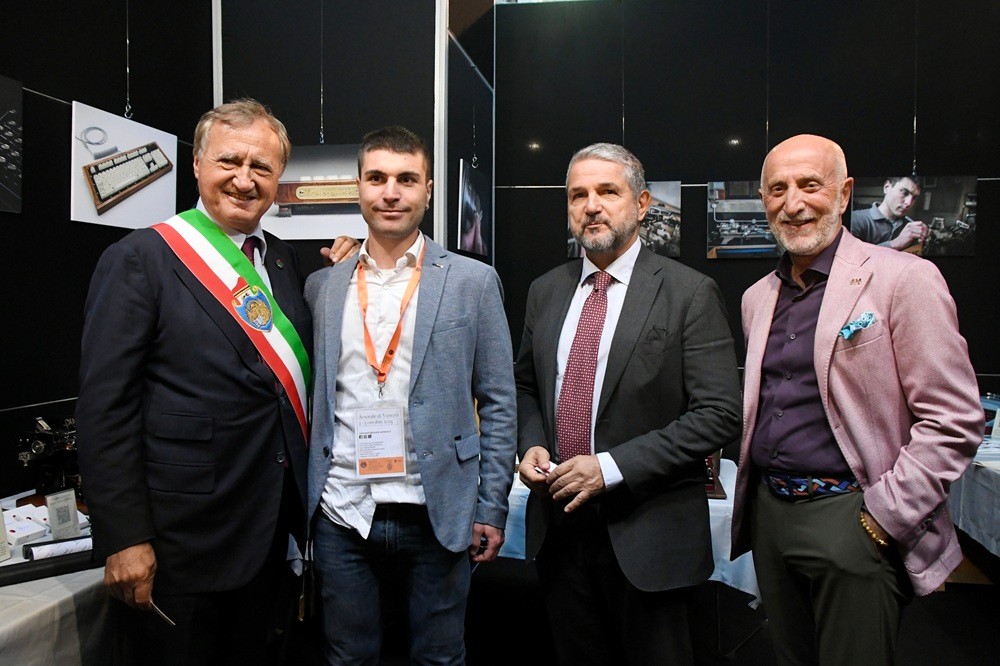





Vescovo Restauri primarily focuses on restoring typewriters entrusted to us by our clients. Occasionally, a limited number of machines are selected and carefully restored, making them available for immediate purchase. These pieces represent unique opportunities for collectors, enthusiasts, or anyone seeking a distinctive and meaningful gift. To promote our work and celebrate Italian craftsmanship, we also participate in selected exhibitions and fairs, including the Salone dell’Alto Artigianato Italiano, held in the historic Arsenale of Venice.
On these occasions, several fully restored typewriters are displayed, including both standard office machines and portable models. During the exhibition, visitors have the opportunity to try them and purchase them directly. Moments like these are special, as it is a pleasure to see the enthusiasm of collectors experiencing the joy of writing on beautifully restored typewriters. If you are unable to visit us during these events, this webpage remains available as our online catalogue, where you can browse the machines currently offered, view their prices, and read detailed descriptions of each restored typewriter.
The difference between buying a typewriter at a flea market and purchasing one from a professional restorer is substantial in terms of quality, reliability, and overall value. See key aspects in the table above.
| Feature | From a Restorer | From a Flea Market |
|---|---|---|
| Working condition | Guaranteed perfect, with written test certificate | Often not working; if lucky, only partially functional |
| Cleanliness | Ultrasonically cleaned and treated with petroleum solvents (watchmaking standard) | Dust and rubber debris inside; at best superficially cleaned |
| Lubrication | Perfect, with new oil and grease applied where needed | Either completely dry or sprayed with WD-40 everywhere |
| Paint condition | Excellent if original, or professionally repainted | Often poor; if repainted, usually done with spray cans |
| Wood condition | Restored with shellac (French polish) and treated against woodworms | Possibly cleaned, but woodworms may still be present |
| Carriage cord | New, recently replaced | Original, likely close to breaking |
| Platen (printing roller) | Newly recovered with fresh rubber | Old, hardened and uneven |
| Ink ribbon | New, freshly manufactured | Almost always dry |
| Reliability | Reliable for many years | Low |
| Warranty | 2 years | None |
| Fiscal invoice | Always provided | Not a chance |
| Typical price (Olivetti M20) | €3500 | €150–500 |
Buying from a flea market can certainly be a good option for those willing to accept uncertain functionality and average cosmetic condition, as the price of a single professionally restored machine can equal the cost of dozens of unrestored ones. However, the significant cost of a restored typewriter reflects the work involved in restoration, as typewriters are extremely refined, complex, and delicate mechanical objects.
I often share a simple example with my clients: a mechanical automatic Rolex Submariner watch consists of around 256 individual components (including the bracelet), whereas an Olivetti M1 contains more than 6,000 parts. In other words, the overall mechanical complexity of an Olivetti M1 is roughly twenty times greater than that of an automatic Rolex. And yet, paying €3000 to service a Rolex is often considered a great deal, while spending the same amount on a typewriter may seem excessive. This difference is purely of perceived value.
Restoring a machine such as an antique machine requires many days of skilled labor. In fact, up to 90% of the final price reflects the restoration work itself, while only a small portion corresponds to the intrinsic value of the machine as it might be found at home or in a flea market.


Year of Production: 1934;
Font: Italico Rodrian 2.6mm;
Keyboard layout: QZERTY;
Paint Condition: original;
Price: €3,400 (VAT included).
This is the most sought-after version of the Olivetti MP1, prized for its exceptional combination of features: the iconic red color made famous by Xanti Schawinsky’s advertising poster, and the elegant, highly desirable Italico typeface, 2.6 pitch (no. 64 AR), produced by the German foundry Alfred Ransmayer & Albert Rodrian. The original paintwork is in very good condition—an uncommon stroke of luck—and the type slugs are likewise excellent. Today’s global trend increasingly favors the collection of typefaces themselves. The combination of a rare early-production red MP1 and such a coveted font (AR no. 64 Italico) makes this typewriter both highly valued on the market and worthy of consideration as an investment piece. The Italico typeface, also known as cursive or aldino—after Aldus Manutius (Venice, c. 1500)—is an inclined font that evokes handwritten text without imitating it. It should not be confused with the “script” typeface, designed to mimic graceful handwriting, which was also produced for typewriters. The Olivetti MP1 presented here has been fully restored, with all rubber parts replaced and precision alignment of the type slugs ensuring you the highest writing experience. It comes complete with its original wood-lined carrying case.
Reserve This Unique Piece
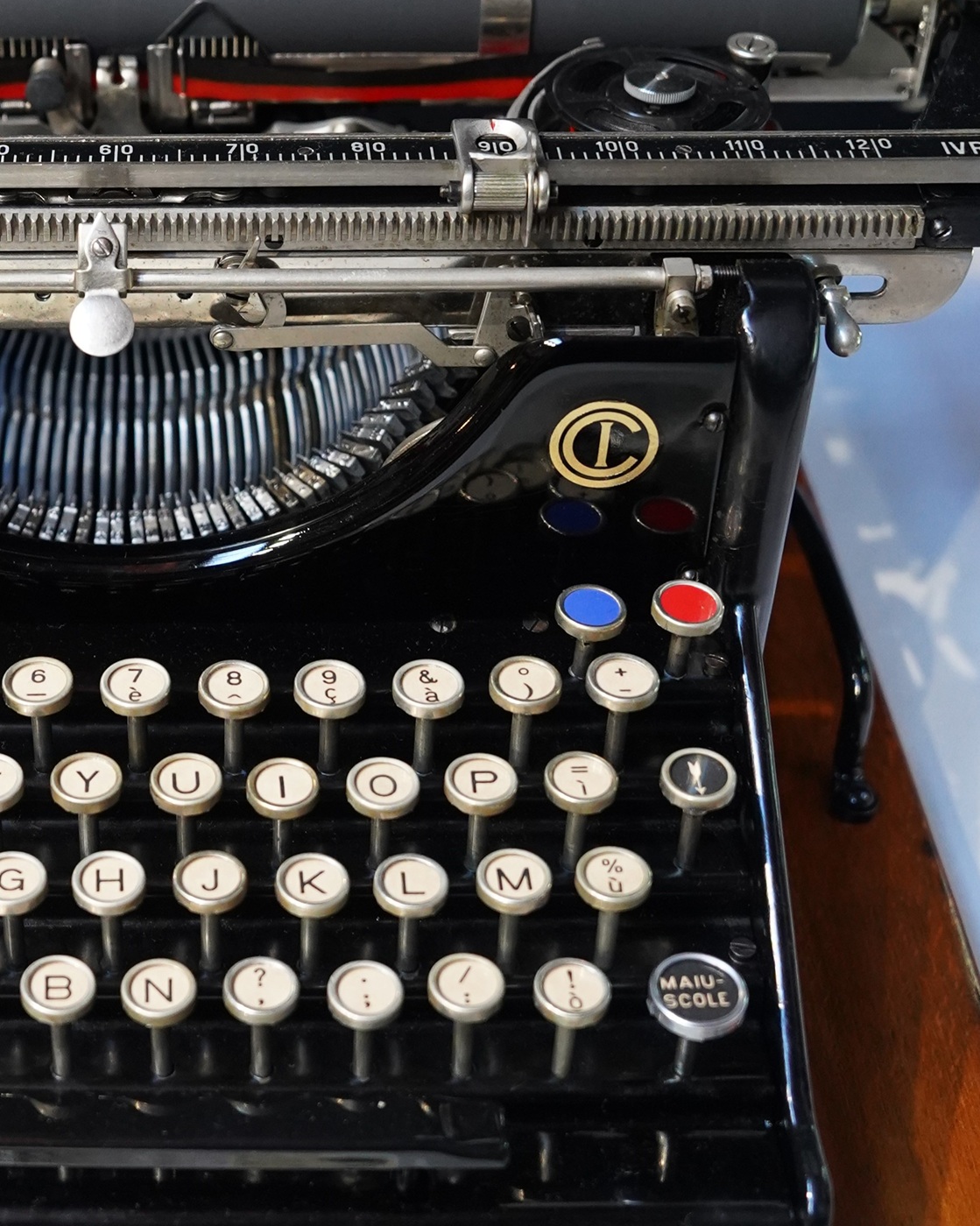


Year of Production: 1927;
Font: Pica Olivetti 2.6mm;
Keyboard layout: QZERTY;
Paint Condition: original;
Price: €3,500 (VAT included).
The Olivetti Model 20 is a wonderful Italian typewriter when presented in such finely restored condition, complete with its solid hardwood base, polished using the ancient shellac pad technique, like in Stradivarius violins. This base is not merely functional, but reflects Olivetti’s commitment to quality: Olivetti continued to use solid wood well into the late 1940s, unlike most manufacturers who had already adopted laminated solutions. Carefully constructed from interlocking wooden elements, it ensures remarkable stability and durability over time. It was the second typewriter model produced by Olivetti, following the M1, to which it bears a strong aesthetic resemblance—so much so that some mistakenly confuse one for the other. Although mechanically simpler than the M1, it nevertheless remains quite a complex typewriter to restore.
Reserve This Unique Piece


Year of Production: 1935;
Font: Pica Iris 2.6mm;
Keyboard layout: QWERTZ;
Paint Condition: original;
Price: €1,600 (VAT included).
The most beautiful of all Everest typewriters, in a rare garnet-red color and in perfect state of preservation! Produced in Milan in 1935, this model was one of Olivetti’s main competitors. The specimen offered here comes from the early production run, as indicated by its low serial number and by the rear decal, which bears the company’s original name: “Carish & C – MILANO." This was the second model produced under the Everest brand and belongs to the intermediate “studio” category: portable machines that were not overly compact, intended for more intensive use than ordinary portables, but less so than the standard office typewriters. Looking at the typewriter and its period advertisements, one’s mind goes immediately to the so-called autarchy era, conventionally dated from 1935. Yet, setting aside the clichés of “cardboard shoes” and making a careful, detailed comparison with the most prestigious American machines of the same year and category—such as the Royal—we discover that in many respects the Everest proves surprisingly superior.
Reserve This Unique Piece


Year of Production: 1956;
Font: Imperial Elite 2.23mm;
Keyboard layout: QZERTY;
Paint Condition: new 2K;
Price: €1,200 (VAT included).
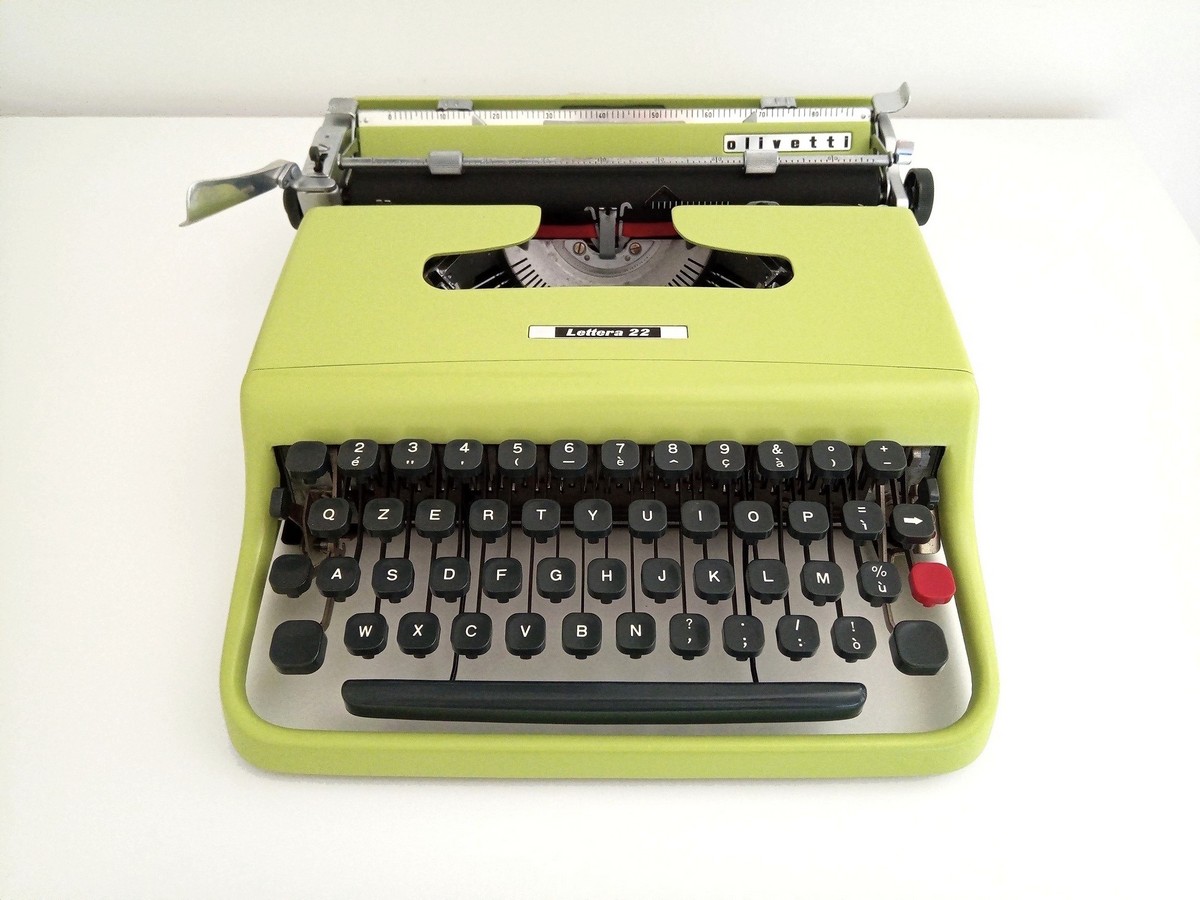
The most famous of all Olivetti portable typewriters, a true icon of Italian industrial design recognized worldwide! The Lettera 22 proposed here is a first-series model, identifiable by its distinctive round-shaped black keys. Celebrated for its elegance, compact form, and remarkable engineering, this early version embodies the essence of mid-century design, combining functionality with refined aesthetics. Its slightly firm touch and responsive action offer a satisfying and engaging typing experience, appreciated by both collectors and enthusiasts. The typewriter presented here has been fully restored both mechanically and aesthetically, with high-quality 2K automotive paint applied to revive its original sheen. Its platen and ribbon system have also been carefully overhauled, ensuring crisp, even impressions with every keystroke. It is fitted with a refined Bodonian typeface, designated by Olivetti as No. 84 Imperial Elite - 2.23 mm character pitch (approx. 11.4 cpi), known for its elegant proportions and excellent readability.
Reserve This Unique Piece





Year of Production: 1961;
Font: Pica Olivetti 2.6mm;
Keyboard layout: QZERTY;
Paint Condition: new 2K;
Price: €1,200 (VAT included).
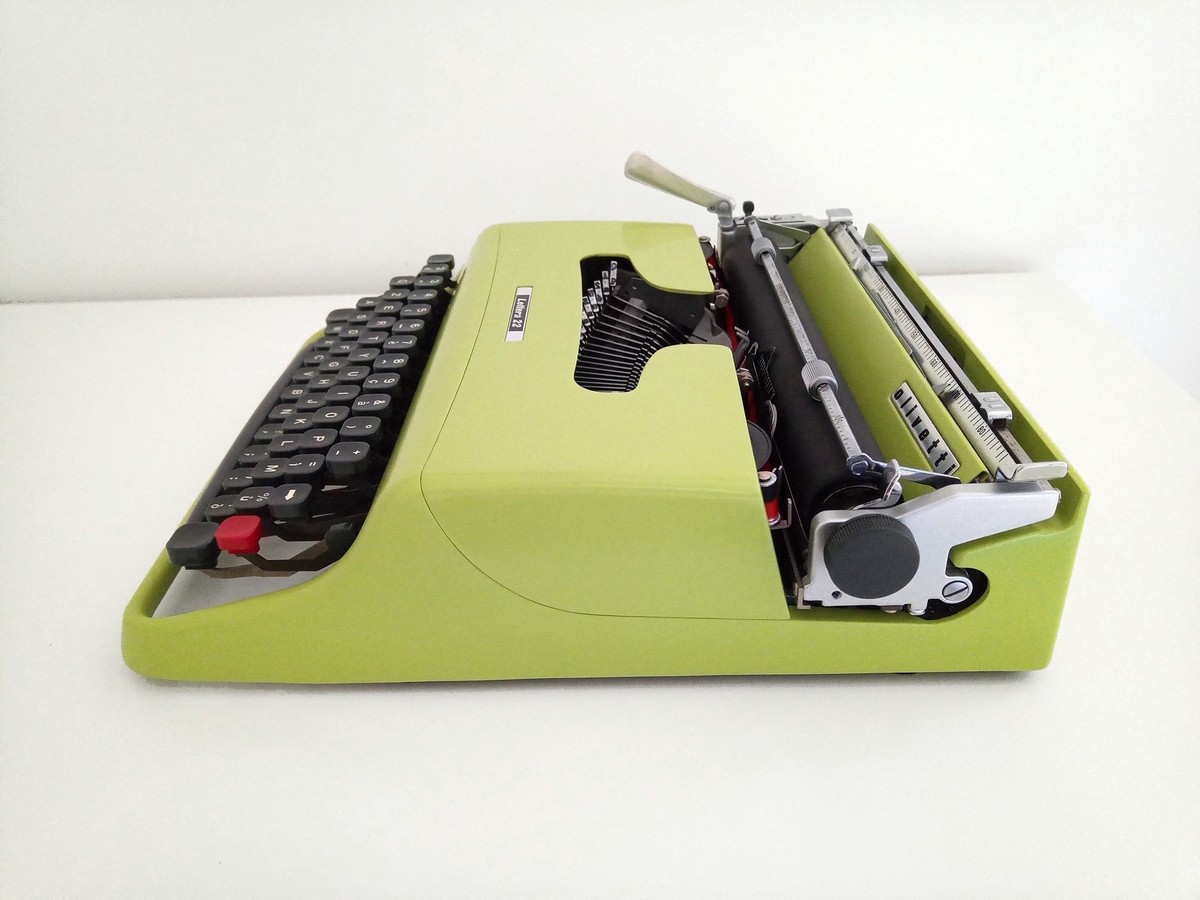
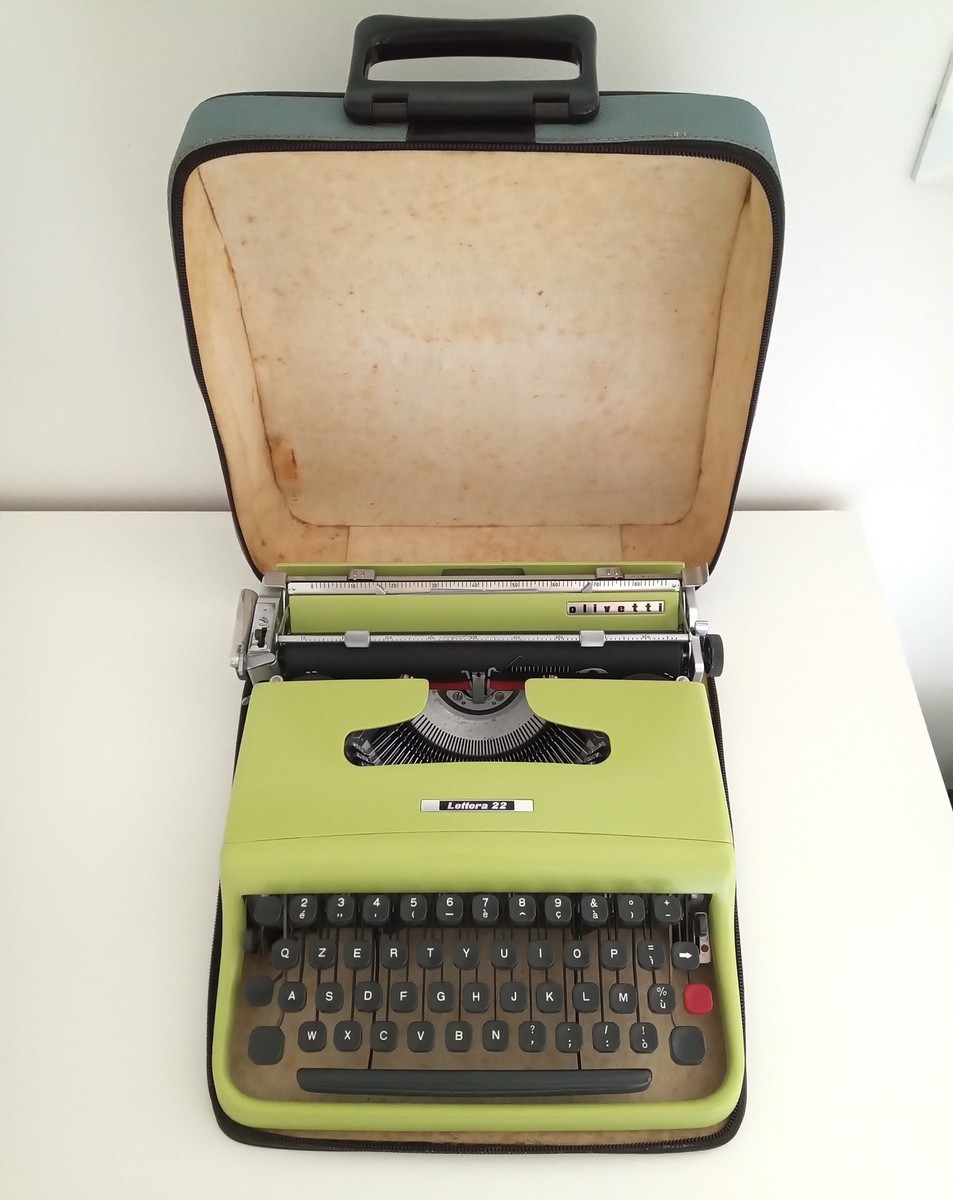
A second-series Olivetti Lettera 22 can be recognized at a glance by its square-shaped keys, while mechanically it remains largely unchanged from the first series, apart from minor modifications such as improved key travel and slightly adjusted tension for a smoother typing experience. While the first series is more iconic and suitable for display purposes, the second series is far more desirable for typing enthusiasts, thanks to the undeniable comfort of the square keys compared to the round ones. The typewriter presented here has been fully restored both mechanically and aesthetically, with 2K paint of a car body shop applied to bring out its original sheen. Its platen and ribbon system have also been overhauled, ensuring crisp, even impressions with every keystroke. This model represents a perfect balance between historical charm and practical usability, making it an excellent choice for both collectors and writers.
Reserve This Unique Piece


Year of Production: 1952;
Font: Pica Olivetti 2.6mm;
Keyboard layout: QZERTY;
Paint Condition: original;
Price: €900 (VAT included).
The Olivetti Studio 44 was introduced in 1952 as an intermediate choice between the Olivetti Lexikon 80 and the Lettera 22. It is, in fact, a well-executed hybrid of these two models: the first being standard and quite expensive, the second portable and affordable. From the Lettera 22 it retains the compact design, the ability to be carried in a case, and the structure of the mechanism—that is, the system of levers transferring motion from the keys to the typebars. From the Lexikon 80 it inherits the escapement operation on a polished cylinder, the carriage with roller supports, and many refined high-level adjustments. It is an extraordinarily well-made model, with a very pleasant touch reminiscent of the Lexikon 80 and the comforts of a “studio” segment, capable of providing its user with a truly enjoyable typing experience. Indeed, countless international typewriter enthusiasts have recognized its incredible capabilities, placing it among the best typewriters of all time. A highly recommended choice both for newbies and experienced users!
Reserve This Unique Piece



Year of Production: 1961;
Font: Pica Olivetti 2.6mm;
Keyboard layout: QZERTY;
Paint Condition: original;
Price: €600 (VAT included).
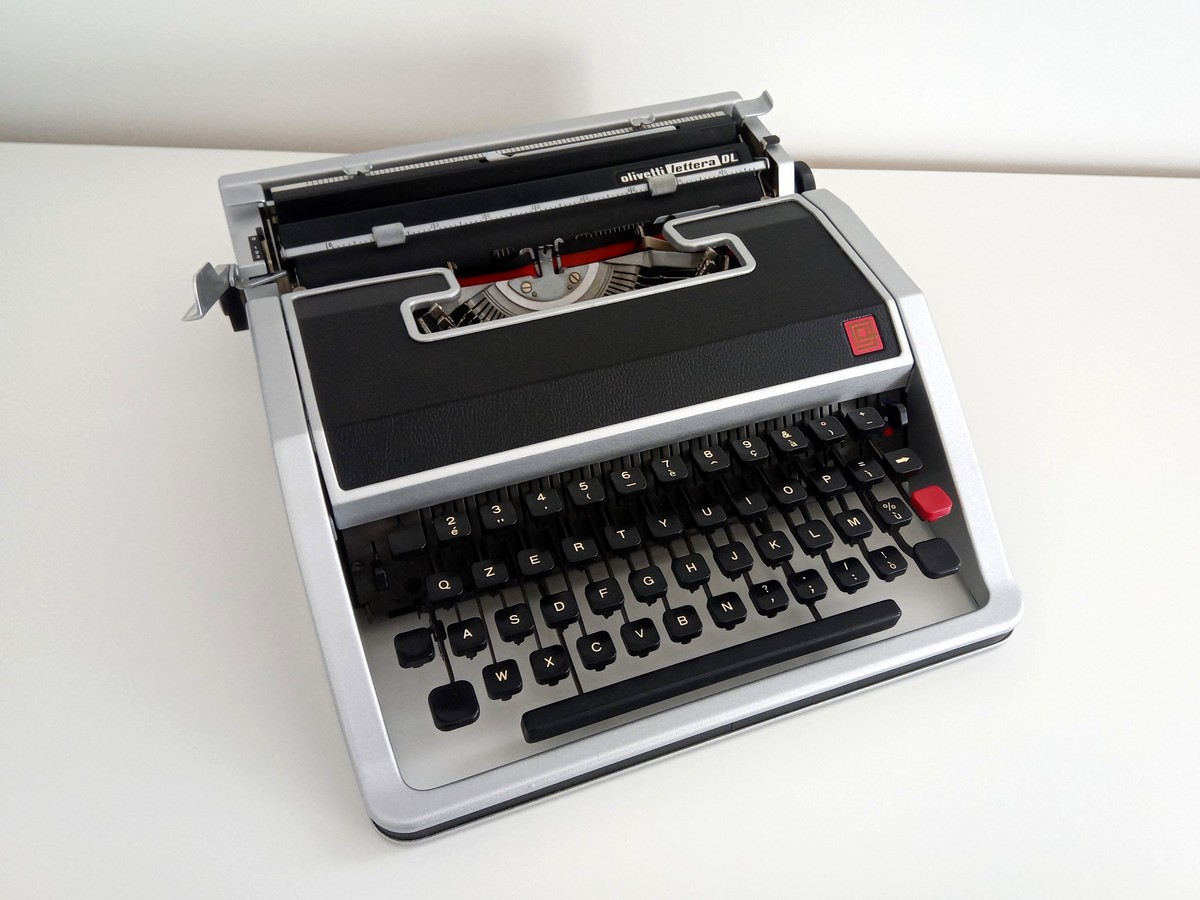
Mechanically identical to the Olivetti Lettera 32, but with superior mechanical finishes that provide an even more enjoyable typing experience, paired with a design that remains modern to this day. It is no coincidence that the acronym “DL” stands for De Luxe. Fully restored and in excellent working condition, this typewriter combines flawless functionality with a pristine appearance, offering both reliability and aesthetic appeal. Complete with its original red eco-leather case, this typewriter can go wherever you go—you certainly won’t go unnoticed, as this is deliberately an elite model. From a collector’s perspective, it is particularly interesting, as this specimen comes from the first year of production, according to its serial number.
Reserve This Unique PieceSome of our most beloved machines have already found new homes. Here’s a look at a few of the typewriters that our collectors and writers couldn’t resist!