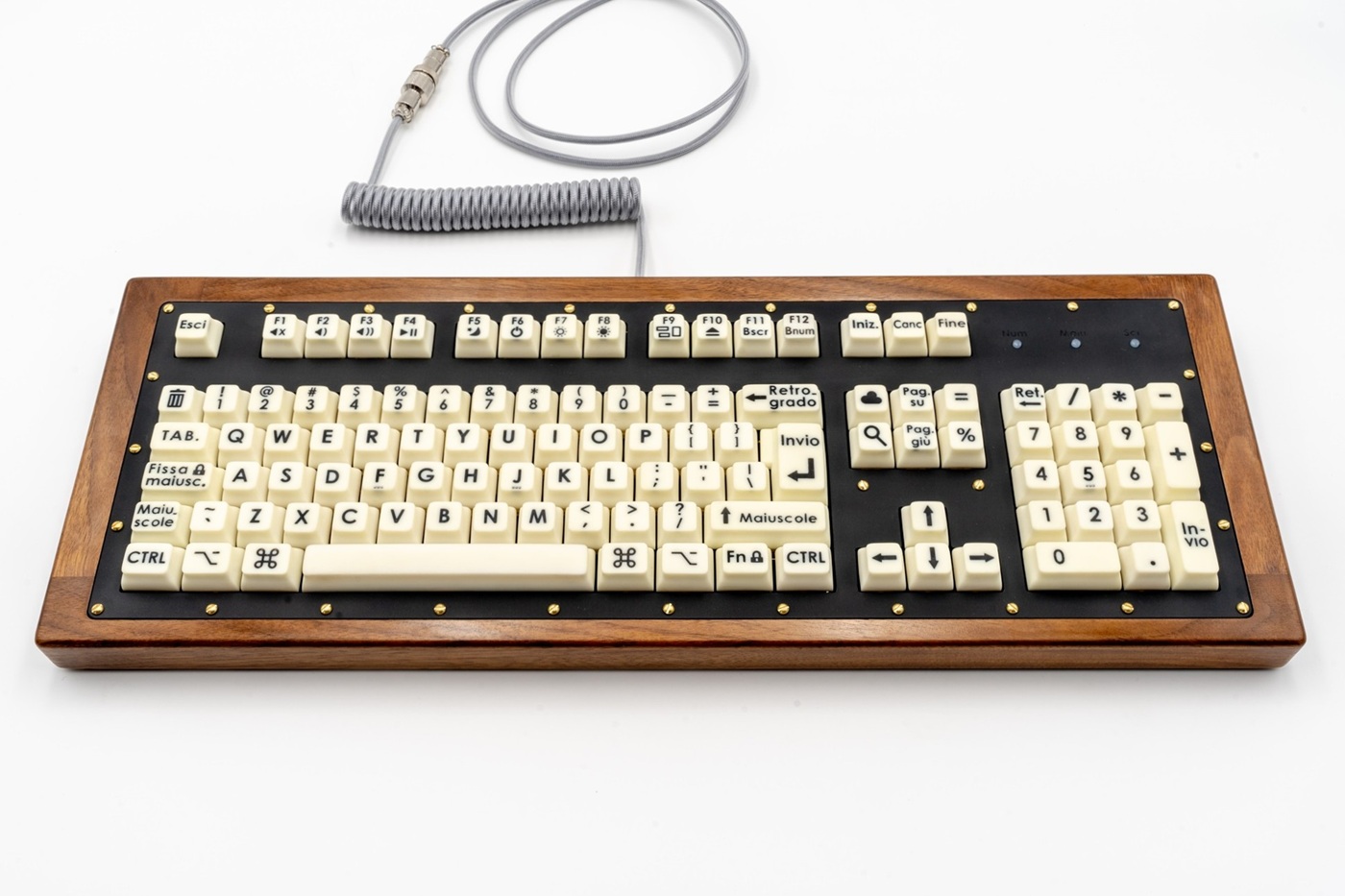




Vescovo mechanical keyboards, with their unique design and premium finishes, can be the perfect everyday work tool as well as a source of inspiration. Designed and made in Italy to pair with your personal computer, they are crafted from high-quality materials such as aluminum, brass, and solid wood sourced from selected timbers.
The double-shot resin keycaps are handcrafted one by one, featuring a distinctive surface texture that provides a realistic tactile feel. The sound has been carefully engineered through various technical solutions: like a musical instrument, different keys produce different tones. Thanks to the elegant yet durable birch wood carrying case, you can take it with you anywhere.
It is now available for the international market with a 105-key US QWERTY layout (ISO) and a 105-key Nova QWERTY — a modern proprietary layout by Vescovo, designed for multilingual typing across Western European languages, including English, French, Italian, Spanish, Portuguese, and German.
The model shown in the photo features a refined combination of finishes: the base is crafted from solid American walnut wood, chosen for its rich texture and natural warmth, while the insert is made of matte black anodized aluminum, offering a sleek and modern contrast. It is equipped with NovelKeys-Kailh switches (linear, self-lubricating POM, 55cN actuation force), delivering a smooth and precise typing experience. The keyboard adopts a QWERTY US International layout (ISO mounted) and is fully compatible with macOS. It also includes a dedicated Spotlight search key and a custom cloud key for enhanced functionality.

A mechanical keyboard for a personal computer is very different from the typical keyboards commonly found on the market. In many ways, it resembles the keyboards of the finest typewriters. Just like on a typewriter, there is no need to press the key all the way down with force: a quick touch is enough, while the remaining travel simply adds comfort. If you spend many hours typing each day, a mechanical keyboard with switches and a layout suited to you can make your workday far more enjoyable — and you may soon wonder how you ever managed without it.

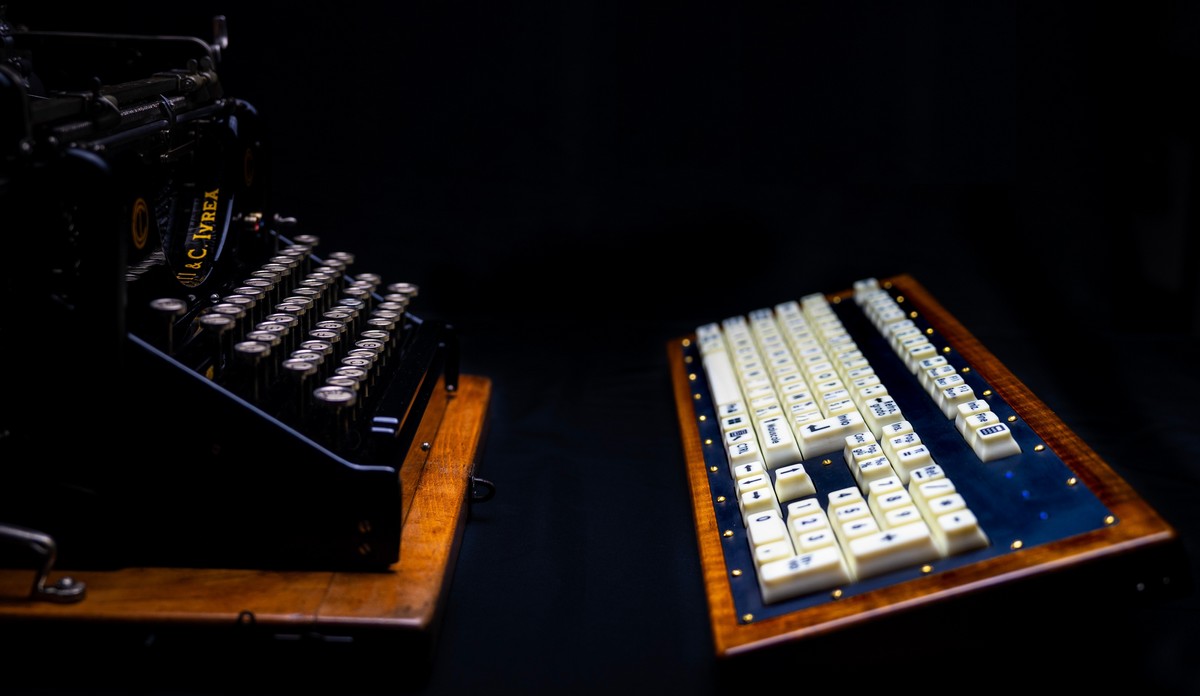 The design of Vescovo keyboards represents a harmonious convergence of different eras of writing, a true fusion between the present and the various past periods when typewriters, especially Olivetti models, were the central tool. My workshop is a leading European reference point for the restoration of these typewriters. The oldest typewriters were black and set into a solid wooden perimeter base with a squared shape. Similarly, this wooden base is present on the keyboard. The black metal insert on the keyboard represents the typewriter itself, but unlike the typewriter, it is flush with the wood rather than protruding; this symbolizes that the typewriter hasn’t disappeared from our existence but has been absorbed by the disruptive force of modern technology.
 To understand the distinctive hourglass shape of the keycaps, we must look back to another historical period. The inspiration comes from the renowned Olivetti Tekne and Praxis 48, designed in 1964 by the duo Sottsass and Von Klier, celebrated for their exceptional typing comfort throughout the typewriter world. One of the many goals of the Vescovo keyboard was to become a reliable working tool for Italian professionals, which is why the comfort of the square key was favored over the classic round one. This innovative hourglass shape was patented (Ref. application no. 015027256-002).
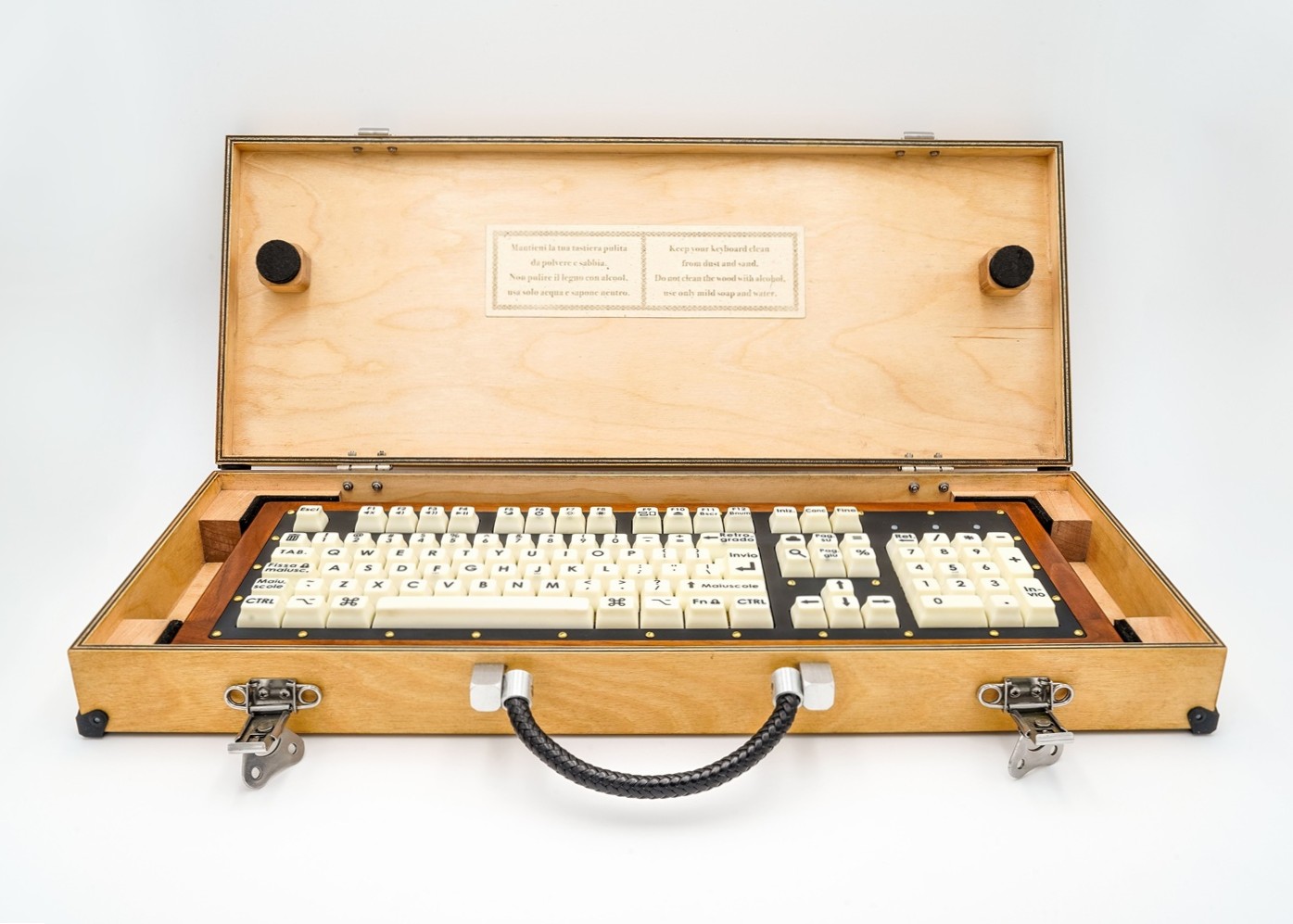 With its braided genuine black leather handle, distinctive butterfly latches, and laser-engraved logo, this sturdy birch plywood case —refined down to the smallest detail— allows you to carry your mechanical keyboard wherever you go. The wood retains its natural color, finished with a coat of paraffin oil followed by two hand-applied layers of shellac using a traditional pad technique. Inside, the keyboard is securely held in place by carefully positioned felt inserts, which keep it stable without the risk of scratching. The total weight of the case and keyboard is 3.3 kg. Just slightly more than a Hermes Baby typewriter and a bit less than a Groma Kolibri.


The wood finish is not achieved using synthetic varnishes, but through the application of natural shellac using a traditional pad technique –just like the finest Italian violins of the 1600s– also known as "French polishing".  This antique process is long and complex, consisting of three distinct stages and requiring many hours of meticulous work, punctuated by days of waiting. But the result is nothing short of extraordinary. The first stage, known as "pomiciatura", aims to seal the pores of the wood to create an smooth surface. It involves spreading pumice powder over the piece and vigorously rubbing it with a pad soaked in an alcohol and shellac solution, using small circular motions. After this, the wood must rest for two days before being finely sanded down to bare wood again, now with the pores sealed. The second stage is the "lucidatura" or polishing phase, which consists of 12 passes with the pad, each soaked in a precise mixture of alcohol and shellac. Every pass must follow a specific technique and be followed by hours of drying time before a light sanding can be performed. The final and most delicate stage is called "brillantatura" or glossing. A very diluted shellac solution is gently applied along the grain with the pad, removing even the smallest surface imperfections and giving the wood its unmistakable sheen. One of the most remarkable qualities of shellac is that it never cracks over time.
  Furniture and violins finished with shellac centuries ago still retain a flawless surface, while wooden objects coated with synthetic varnishes typically begin to crack and deteriorate after just a few decades. However, unlike synthetic finishes, shellac has a natural molecular structure that makes it more absorbent. This means it can easily take on inks or the pigments of other colored liquids. So, if you use fountain pens… be careful with the inkwell!
The sound of this keyboard is carefully engineered through several technical solutions. Much like a musical instrument, different keys produce slightly different tones. The PCB is perimeter screw-mounted, so the sound of each key varies depending on its distance from the wooden frame. This makes the acoustic behavior closer to that of a musical instrument than a conventional keyboard.

The acoustic concept of the Vescovo mechanical keyboard is inspired by planar speakers such as those made by Magnepan: a wooden frame holds a membrane fixed along the inner perimeter that resonates when the keys are pressed. Because of this unique structure, each key interacts with the membrane slightly differently, producing subtle and nuanced variations in sound across the entire keyboard.
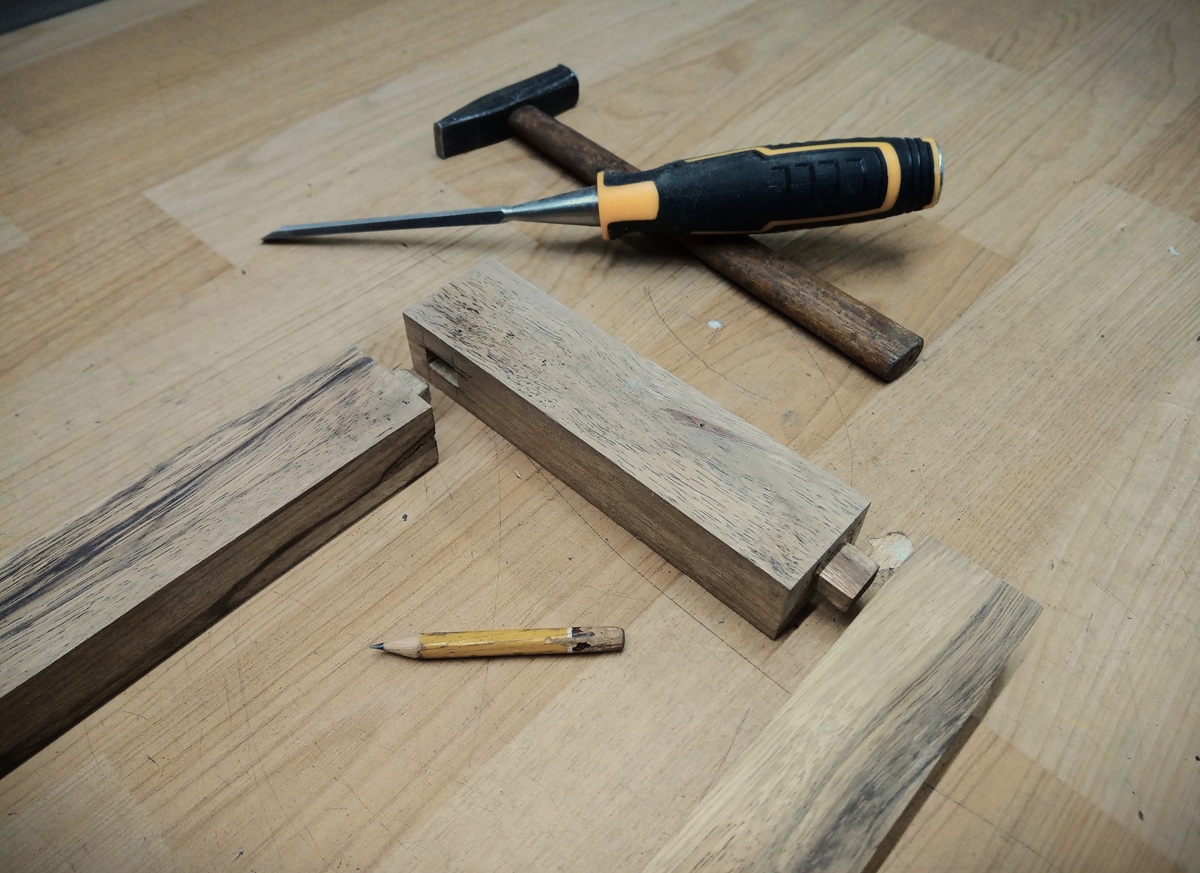 The frame that serves as base for the keyboard is crafted by joining four solid wood pieces using the traditional mortise-and-tenon technique. There are no dowels: the male element is carved directly from the wood itself and then fitted into place. It would be much simpler and cheaper to make the piece from a single block of wood, as many competitors who produce wooden keyboards around the world do. However, you can be absolutely certain that, sooner or later—whether in a few months or in a few decades—keyboards carved from a single block will begin to show cracks and warping. Your Vescovo keyboard, by contrast, will remain as perfect as the day it was made even a hundred years from now, thanks to this meticulous craftsmanship.
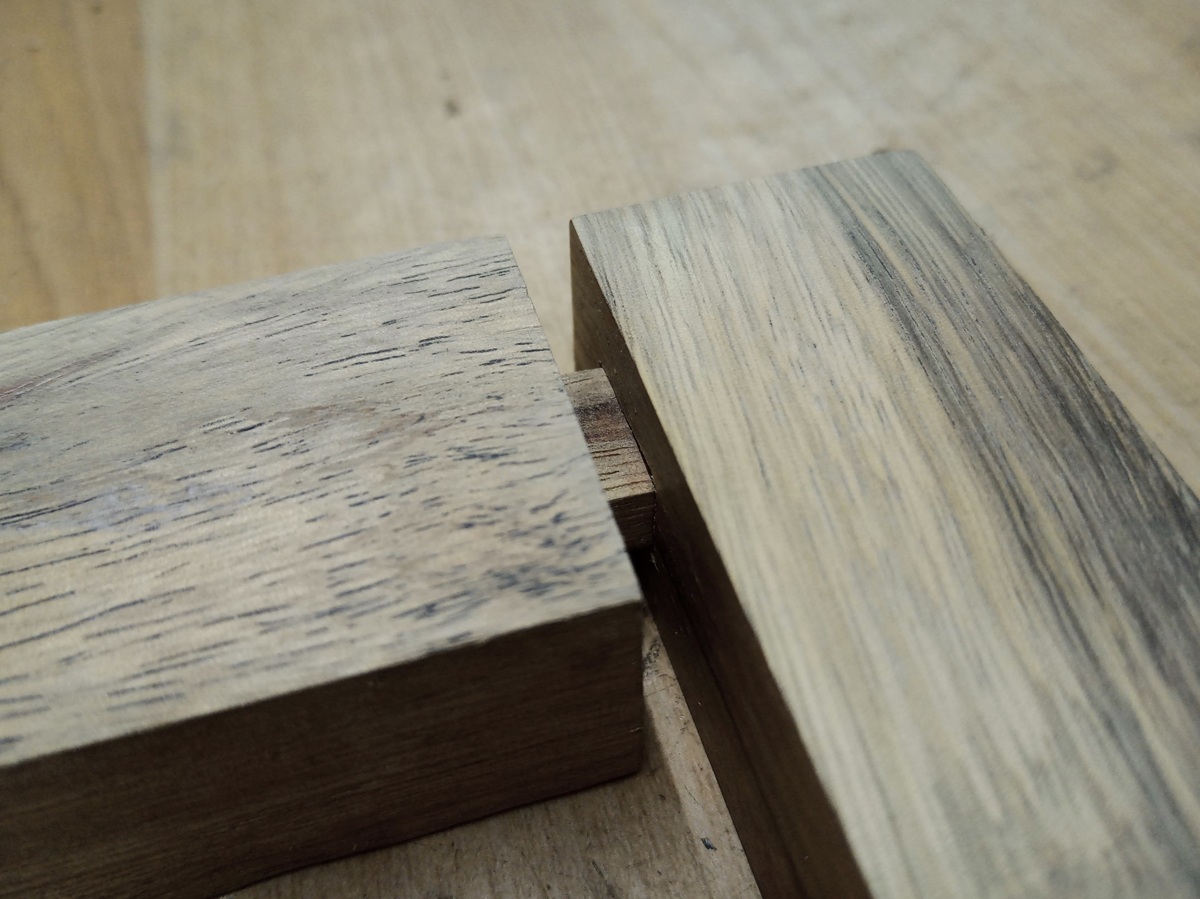 This is because wood is a living material that constantly responds to seasonal changes in humidity and temperature. It expands and contracts differently depending on the direction of the grain: movement along the grain is minimal, while across the grain it can be significantly greater. Over time, this natural movement creates internal stresses in large pieces carved from a single block, which can eventually lead to warping or cracking. Long-term stability is achieved through precision woodworking that combines multiple pieces of solid wood, each carefully oriented, fitted, and glued together. This traditional technique allows the material to move naturally while maintaining the structural integrity and shape of the object.

Italian Walnut (origin Italy):
internationally recognized as one of the highest-quality woods in the world. Its rich brown color pairs particularly well with a matte black anodized aluminum insert, and its natural grain patterns create a varied yet elegant effect, giving a classic and refined look.

American Walnut (origin USA):
with its dark brown color and well-defined, fairly regular grain, it is recommended to pair this wood with a matte black anodized aluminum insert. It is an excellent choice for those seeking a clean, elegant line, valued for its durability and warm tones.

European Oak (origin Croatia):
its golden tones and pronounced grain make it a perfect match for a natural-finish sandblasted aluminum insert, resulting in a keyboard with a distinctly modern appearance, renowned for its strength and elegant, timeless look.

Black Limba (origin Central Africa):
famous in luthiery for its exceptional resonance, only a very small percentage presents irregular black streaks and is known in English as Black Limba, giving your keyboard a decidedly “Rock” character.
Changing the type of switch will affect both the feel and the sound of your keyboard. That’s why it’s important to choose the most suitable one when placing your order. There are always heated debates among mechanical keyboard enthusiasts about which switch is the best, but the truth is that the choice is vast, and the “best” really depends on how you plan to use your keyboard (gaming or writing?) and on personal preference. For this reason, Vescovo keyboards offer a carefully curated selection of ten different switches, so even the most demanding users can find the one that fits their needs. If you're unsure about which switch to choose, don’t worry, it’s completely normal. Just ask, and I’ll be happy to guide you in the right direction.
 Switches generally fall into two main families: linear and tactile. Within the tactile category there is also a subgroup known as clicky switches, which produce a distinct click sound when the key actuates. Linear switches are the most sensitive and allow for theoretically faster typing, particularly when performing rapid repeated keystrokes. However, this sensitivity can also make accidental inputs more likely. Tactile switches address this with a small bump at the actuation point, providing clear physical feedback when the key is pressed and helping reduce unintended keystrokes. Clicky switches build on this tactile feedback by adding an audible click, making each keypress even more noticeable.
Gateron Oil King black: linear, gold-plated contacts, 55cN actuation force.
NovelKeys-Kailh cream: linear, self-lubricating, 55cN actuation force.
Everglide Peacock: linear, gold-plated spring, 55cN actuation force.
Cherry MX Red: linear, Hyperglide, 45cN actuation force.
Cherry MX-2A Black: linear, gold-plated contact, 60cN actuation force.
Everglide Dark Jade: tactile, gold-plated spring, 50cN actuation force.
Cherry MX-2A Brown: tactile, gold-plated contact, 55cN actuation force.
MX Grey: tactile, 80cN actuation force (the highest proposed!).
Cherry MX-2A Blue: tactile with click, gold-plated contact, 60cN actuation force.
Cherry MX Green: tactile with click, 80cN actuation force.
Other switch types can be installed on request, provided they comply with the Cherry 5-pin standard and have a total travel distance of 4 mm ± 0.2. The most popular choices among customers so far have been, in order: Cherry MX-2A Brown, Gateron Oil King black, NovelKeys-Kailh cream, and Cherry MX Green.

A full-size 105-key US QWERTY keyboard with an ISO layout offers distinct advantages for English-centric typing and programming. The ISO design provides a larger Enter key, making line breaks more comfortable and reducing strain during long typing sessions—ideal for programmers, writers, and professionals who work extensively with text. While ANSI layouts are more common in the world of mechanical keyboard, ISO remains a preferred choice for full-size keyboards, combining familiar US QWERTY key positions with improved ergonomics. In practice, a 105-key US QWERTY ISO keyboard delivers greater comfort, accuracy, and efficiency, particularly for programming or extended text input, without requiring users to adjust their key positions.
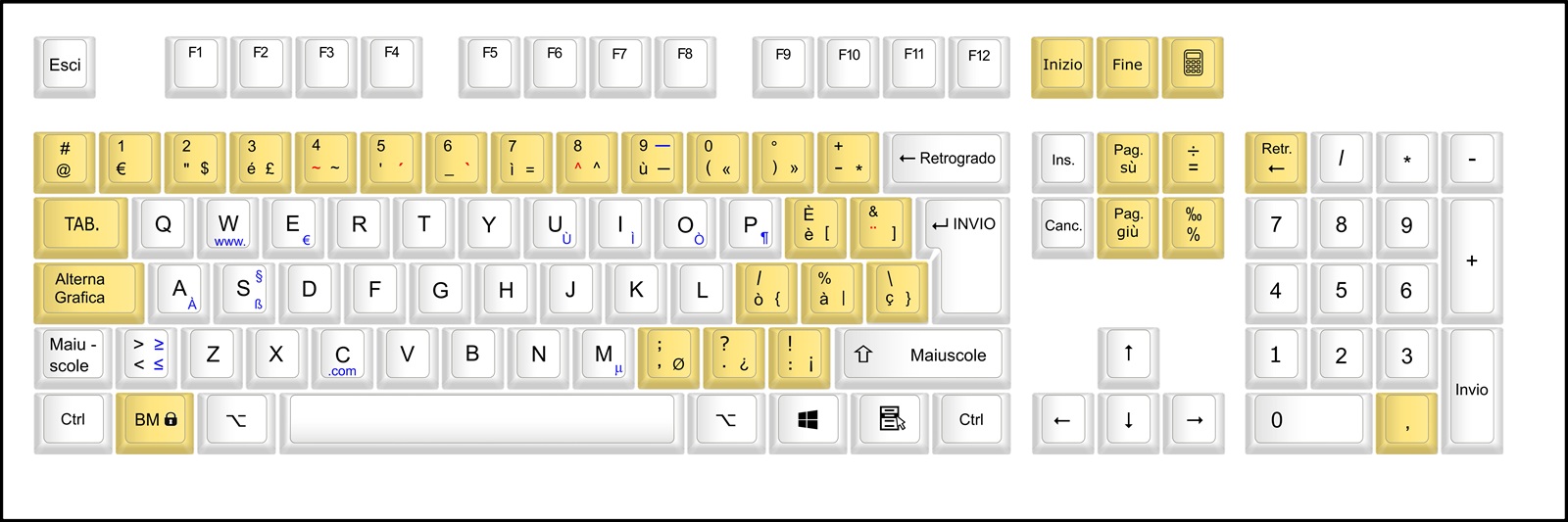
The 105-key Nova QWERTY Layout (ISO) is a modern proprietary layout by Vescovo, designed to support multilingual typing across major Western European languages, including English, French, Italian, Spanish, Portuguese, and German. While maintaining the familiar QWERTY structure, the layout optimizes access to accented characters and offers a practical balance between multilingual flexibility and typing comfort on a full-size 105-key keyboard. Thanks to a combination of dead keys and directly accessible accented vowels—such as à, è, ì, ò, ù, é, and ç—the layout allows users to type naturally in languages that rely heavily on diacritics. This makes everyday writing in French and Italian particularly efficient. Portuguese and Spanish can be typed with roughly the same efficiency as on their respective national layouts, as they largely rely on dead keys, while German—honestly—is possible but less efficient than on a German national keyboard layout.

The 105-key Nuova QZERTY Layout (ISO), developed by Vescovo, is designed to improve everyday writing in Italian and French. Inspired by traditional Italian typewriters, it reorganizes several keys to better match the frequency and ergonomics of these languages. In the standard Italian QWERTY layout, commonly used letters like “Z” and “M” occupy inefficient positions. Typing “Z” requires an awkward backward movement of the left ring finger, while “M” forces the right middle finger to retract—both unnatural and inefficient actions. Meanwhile, rarely used letters such as “W” are placed more accessibly. Nuova QZERTY resolves these issues while also improving punctuation placement. For instance, the apostrophe—frequently used after right-hand letters in Italian—is positioned more ergonomically. It also provides direct access to typographic characters like « », as well as the en dash “–”, widely used in Italian prose as a more elegant alternative to parentheses.
The price of the keyboard is €3,200 and does not vary depending on the finishes you choose. Every Vescovo keyboard is sold complete with its carrying case, a USB-C connection cable, and a keycap removal tool.
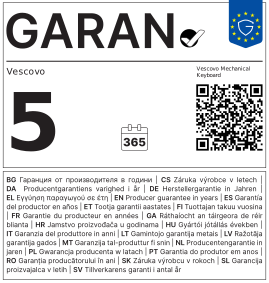
Every Vescovo keyboard comes with a free 5-year guarantee of durability, valid within the member states of the European Union, excluding overseas territories. It covers the entire keyboard and is additional to, and does not affect, the consumer’s statutory legal guarantee rights. The full commercial guarantee statement, including its terms and conditions, is provided before purchase and with the product.