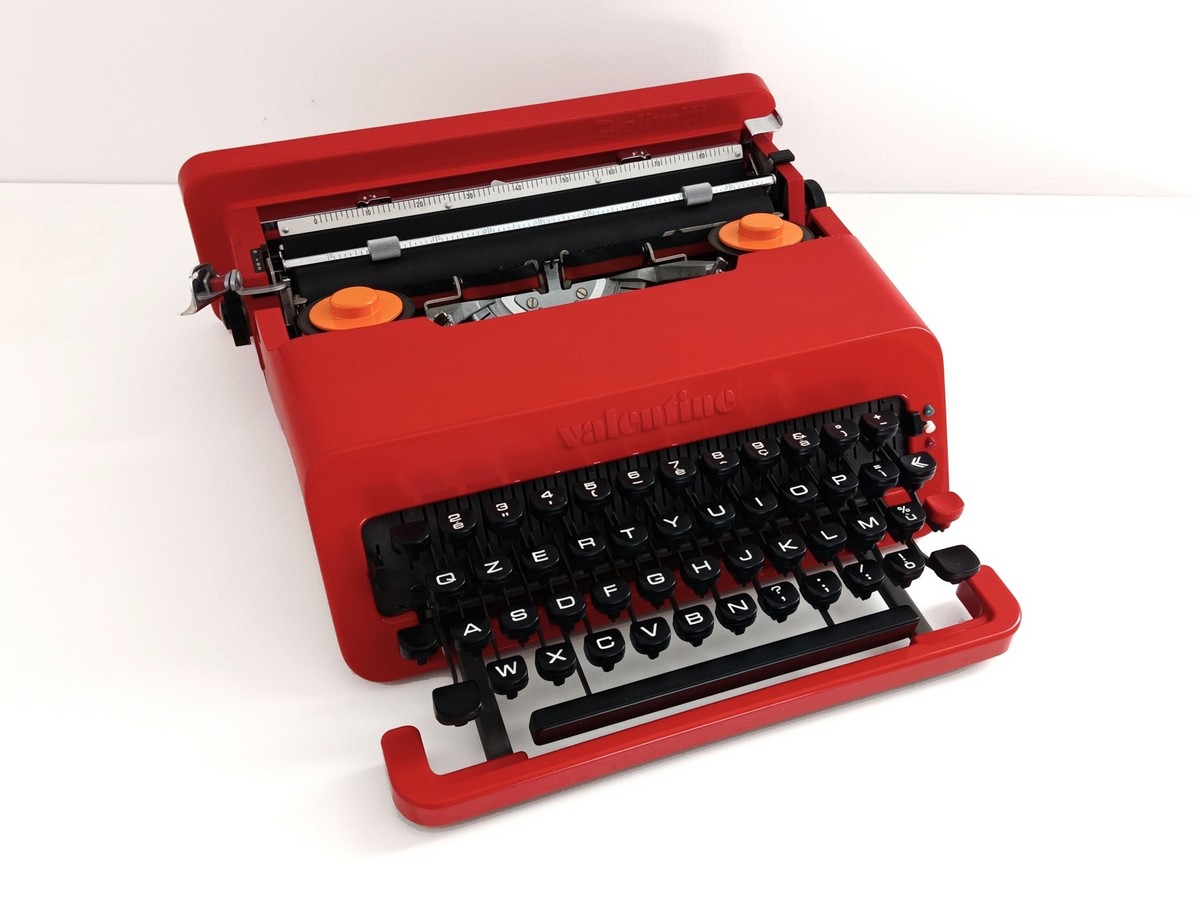
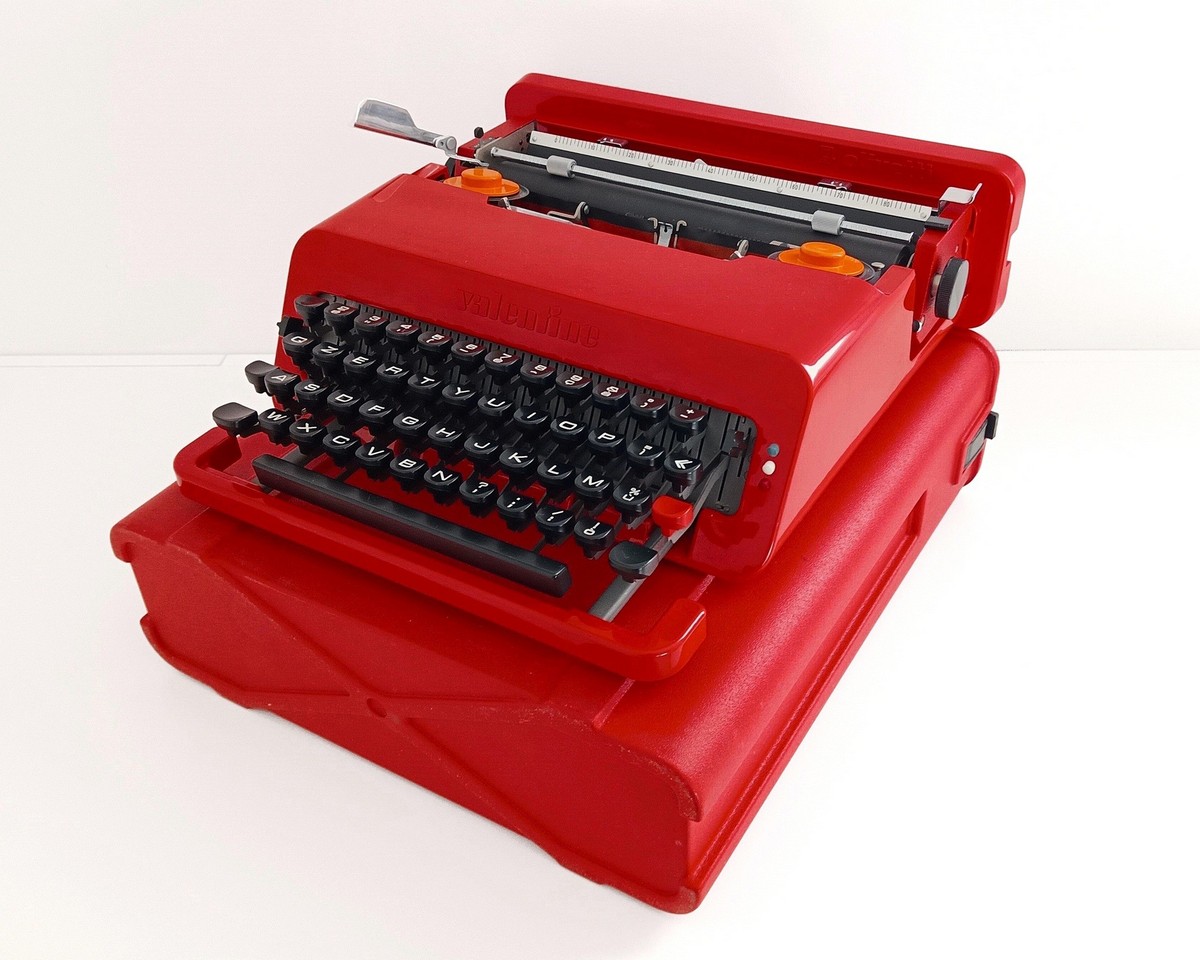
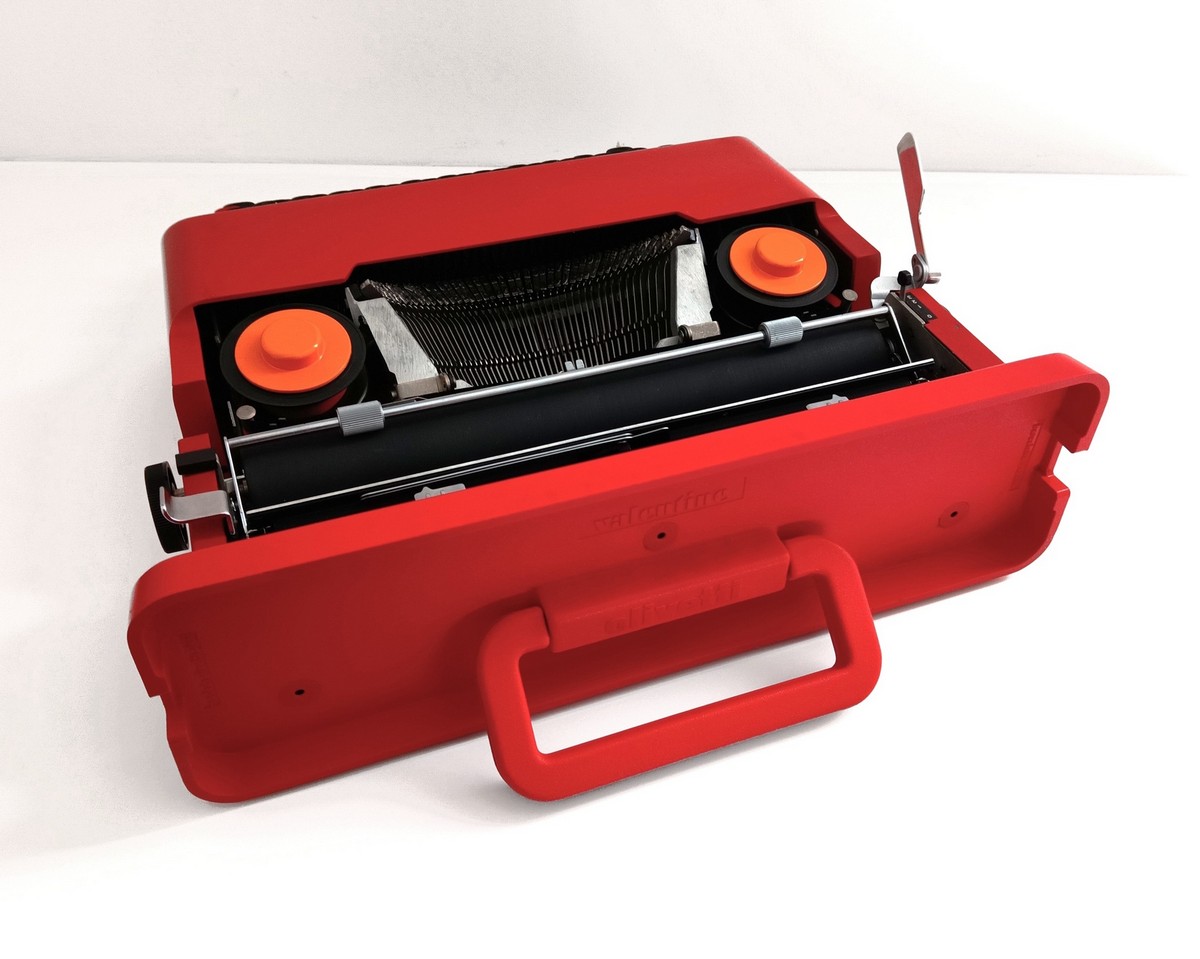



Introduced in 1969, the Olivetti Valentine is probably the most famous typewriter in the world of industrial design. Designed by Ettore Sottsass and Perry King, it was conceived at a time when Japanese typewriter manufacturers were flooding the European market with inexpensive and functional products such as the Brother JP1.
In the original project, the Valentine was supposed to be a direct response to this competition: an inexpensive machine, without a ribbon colour selector, without lowercase letters, and made from Moplen, the same plastic used to manufacture household buckets – yes, the kind that tends to crack after a few years.
 Fortunately for us collectors and mechanical typing enthusiasts, however, at some point during its development the entire philosophy behind the project changed. Olivetti decided to adopt the already proven and good-quality mechanism of the Lettera 32, which had been in production since 1963, and to use coloured ABS resin, which cost five times as much as the “bucket plastic” but offered far greater resistance to impact and ageing. This choice gave the Valentine not only an innovative appearance, but also the reliability and excellent typing characteristics of one of Olivetti’s most successful portable machines. In short, the Valentine evolved from an inexpensive typewriter into a radical design object, conceived not merely to be used for writing, but to be displayed, carried around and experienced. The colours chosen were all distinctly youthful: bright red, white, light blue and vivid green. Its playful and unconventional design broke with the austerity of traditional typewriters, turning it into a cultural status symbol during the 1970s.
It was not designed for the office, but for the home, for young people and for writers “on the road”, and it soon became an icon of Italian design, represented in museums such as the Museum of Modern Art (MoMA) in New York and the Triennale Design Museum in Milan. A typewriter that, although originally conceived to compete on price, ultimately triumphed for an entirely different reason: by becoming a manifesto of Olivetti quality and creativity.
A complete restoration of a typewriter begins with the disassembly of the machine, followed by a thorough cleaning of all mechanical components, first using an ultrasonic bath and then rinse using a petroleum-based solvent.
Once cleaned, every component is carefully dried and reassembled, and then the internal mechanism is precisely lubricated to guarantee optimal performance. The mainspring is also dismantled, cleaned, and reassembled with fresh grease, ensuring consistent tension and smooth carriage movement.
The machine then undergoes a comprehensive adjustment process, including fine-tuning of the kinematics, ribbon lift, and upper/lower case alignment. Components subject to natural wear, such as the ink ribbon, rubber grommets, carriage drawcord, and any weakened springs, are replaced with new parts.

Against stubborn dirt dried after fifty or more years of neglect, the classic combination of kerosene and a brush would achieve very little. I am referring specifically to dried correction fluid, eraser residue —sometimes melted by the heat of an attic—, hardened grease, deposits of sebum mixed with dead skin, and so on. The ultrasonic cleaning tank I use in my restorations was built by a specialized company and is specifically designed and custom-made for cleaning typewriters.


Olivetti Valentine mechanical body before ultrasonic cleaning.

How does it work? The phenomenon involved is cavitation. The powerful waves generated by the sonotrodes are transmitted into the water, creating microbubbles at extremely high pressure that implode upon contact with the object. Using a simple solution of water and soap, a combined action is achieved: a physical high-frequency “micro-brushing” effect together with the degreasing action of the detergent dissolved in the bath. The result is excellent, with a low environmental impact when biodegradable soaps are used.


Olivetti Valentine mechanical body shining after ultrasonic cleaning.

To restore an Olivetti Valentine typewriter to perfect working condition, it is essential to rebuild the various rubber components, which over time tend to harden and eventually crumble completely. Feet, main platen, and both lower and front paper rollers—all must be renewed. Everything is made possible thanks to experience and specialized equipment. For more information, please visit this page.

Precision alignment of the type slugs is carried out using specialized type alignment pliers. I am fortunate to own a complete set of these special tools, which are essential for accurately adjusting the position of each type slug and achieving consistent, high-quality printing. This precise operation is crucial for ensuring that the machine successfully passes the final, rigorous quality inspection.

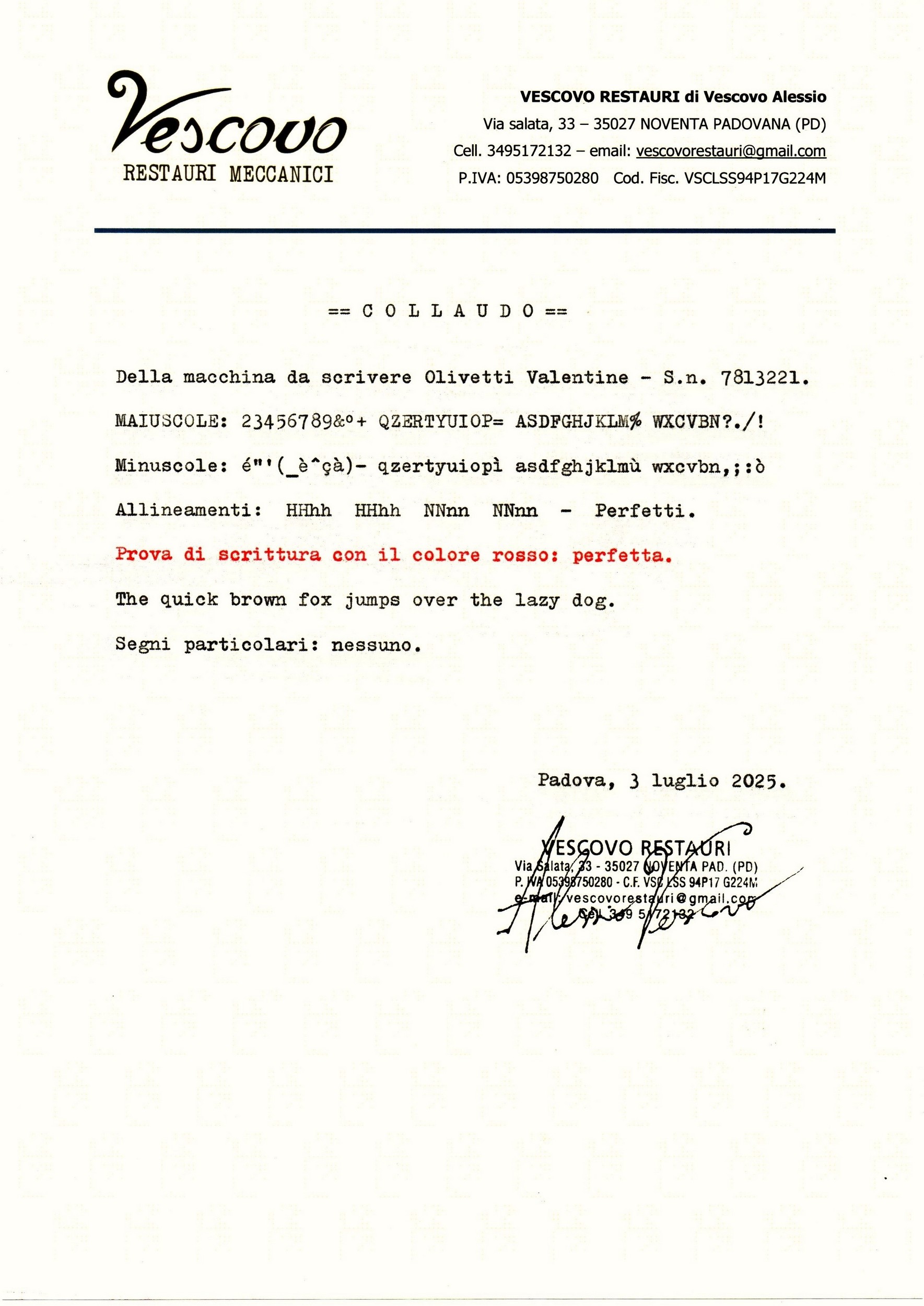
At the end of the restoration, the typewriter undergoes a complete functional test. A final test certificate—typed on the machine itself, signed, and stamped—is issued as proof of successful inspection and completion of the service.