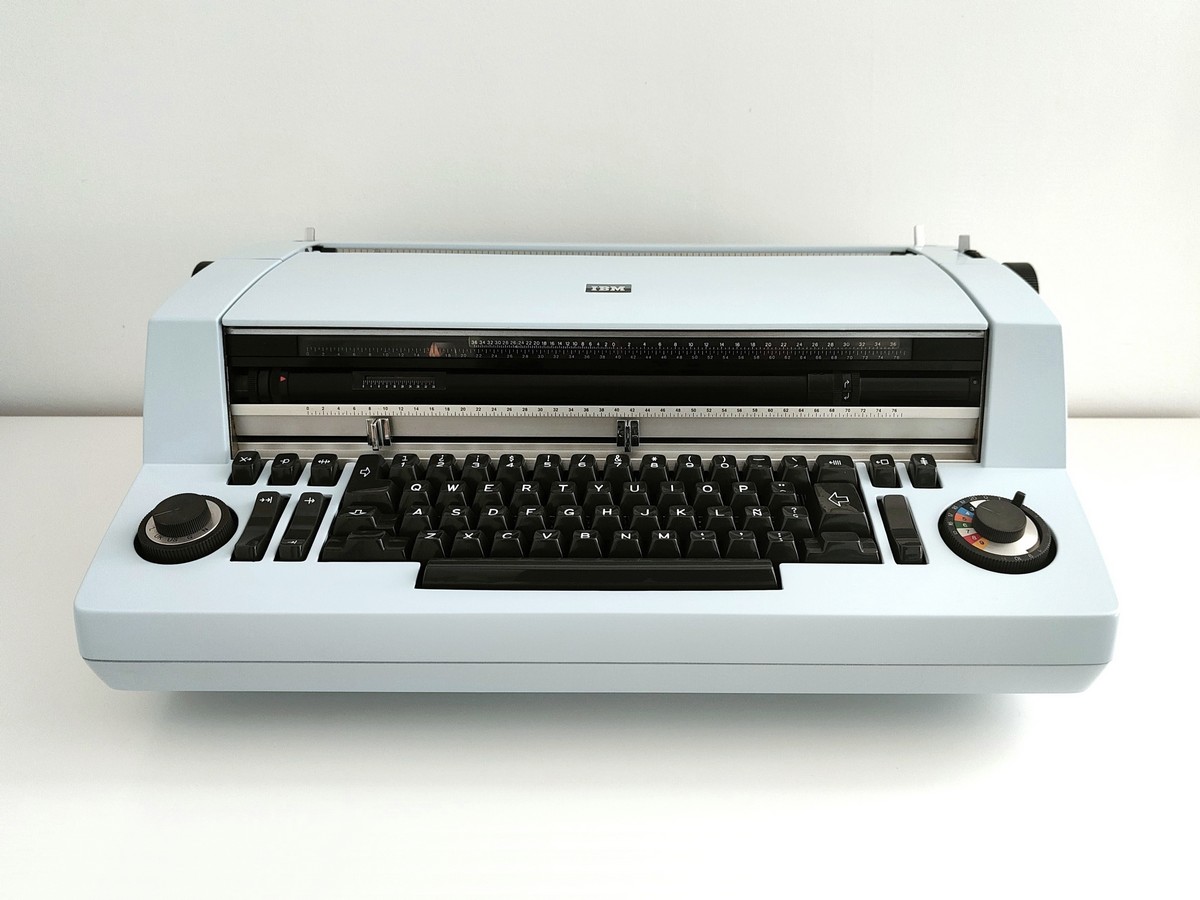
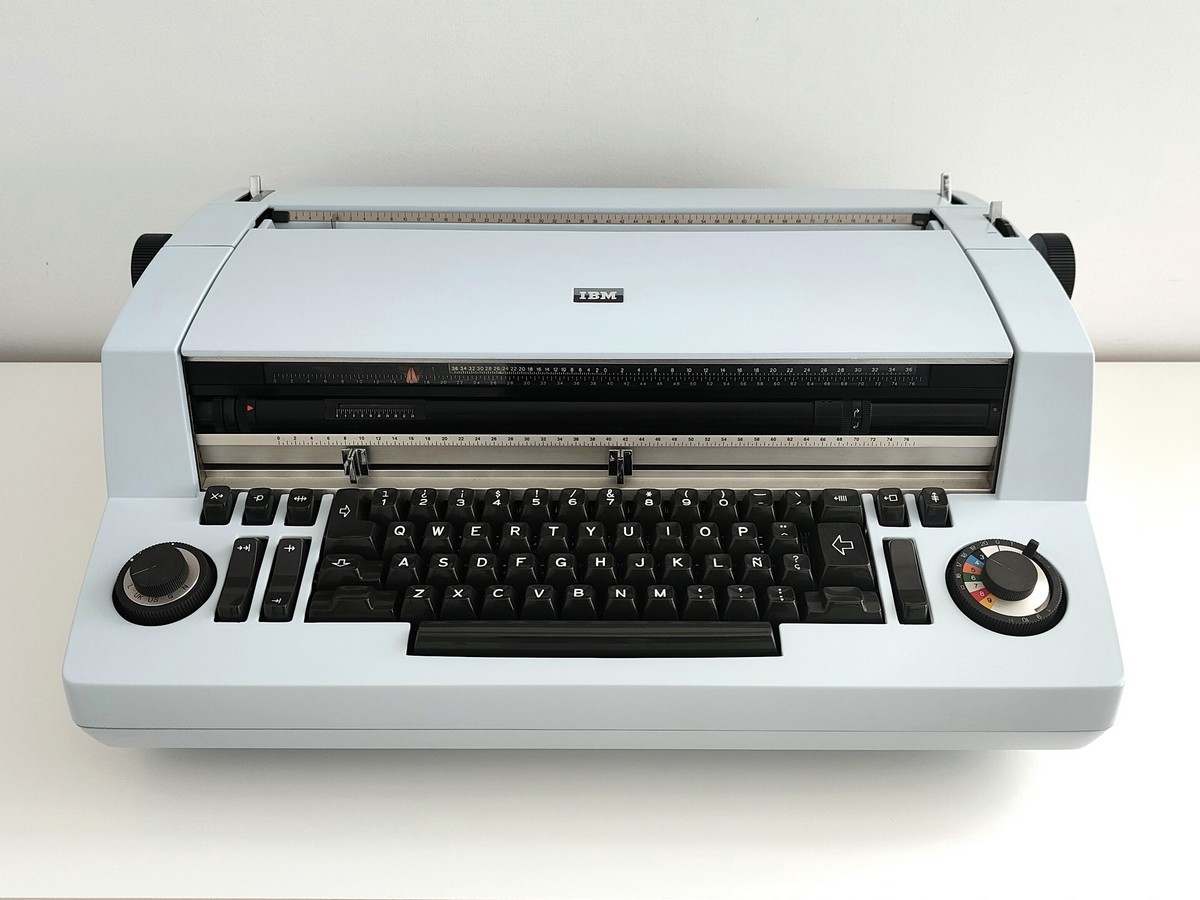





Imagine a mechanical typewriter so complex, so precise, and endowed with so many capabilities that it can truly be regarded as a typesetting machine. A machine capable of proportional spacing, with interchangeable typefaces that can be replaced in seconds. A machine equipped with a small mechanical "brain" operating in binary logic almost like a computer, able not only to process the signals it receives from the keyboard but also to retain them in memory. This, and much more, is the IBM Selectric Composer: the most complex mechanical typewriter ever built—a purely mechanical word processor.
Its electric power supply should not mislead anyone into questioning its fundamentally mechanical nature. Electricity serves only to power a motor that provides the torque required to drive its many mechanical operating cycles; it performs no other function. If we were to remove the motor and instead supply the motion by some other means—for example, with pedals—the machine would work exactly the same way.
 But what was a machine like this actually designed for? Although nothing prevented it from being used for ordinary correspondence, its primary purpose was to produce high-quality originals for offset printing plates. The process differed from the more familiar stencil duplicating method. Instead of cutting a stencil into an inkless waxed sheet (as many will remember, the "stencil" lever found on typewriters existed precisely for this purpose), the Composer produced crisp black text on translucent paper. The page would then be completed by hand, adding logos, illustrations, or other graphic elements. From this finished artwork, a photographic negative was made, which in turn was used to expose the offset printing plate. Compared with traditional hand typesetting, this represented an enormous saving in both time and effort. It was slower than a Linotype, but it offered an extraordinary degree of flexibility. Consider, for example, a mathematical or scientific text requiring Greek letters, integral signs, function symbols, and countless other special characters—features that simply were not available on a standard Linotype. With the IBM Selectric Composer, however, purchasing one or two additional type elements was all that was needed to produce them with ease.
Restoring this particular machine to full working order, with every one of its functions operating exactly as intended, proved to be an extraordinary challenge. The IBM Selectric Composer is a remarkably rare machine; the few surviving examples are almost invariably non-functional, spare parts no longer exist, and the complexity and cost of restoration are considerable. As a result, only a handful of fully operational Composers are known to exist today.


 Typewriters generally use monospaced characters; that means each letter occupies the same width on the page. This made it necessary to create specific typewriter fonts designed to give the text a more uniform appearance, such as Pica, Eletto, Prestige Elite, Courier, and others. In these typefaces, letters like “m,” which would normally take up a lot of space, were compressed, while letters like “i” were expanded. The few typewriter models that used proportional spacing—and therefore required dedicated fonts—met with limited commercial success for many reasons. One of the main issues was that, in the event of a typing error, moving backward correctly required memorizing the widths of all the different letters expressed in basic units. Try writing a short letter on an and you will quickly realize how maddening it could be! As we will see later, on the IBM Composer this problem was completely solved thanks to a kind of “mechanical brain”—the control unit.
Another important quality indicator to consider is the maximum number of basic units per character that a proportional machine can handle: the higher this number, the greater the typographer’s ability to create a truly refined and visually pleasing typeface for it. The IBM Selectric Composer worked with as many as 9 basic units, whereas the Olivetti Graphika, by comparison, worked with only 5.
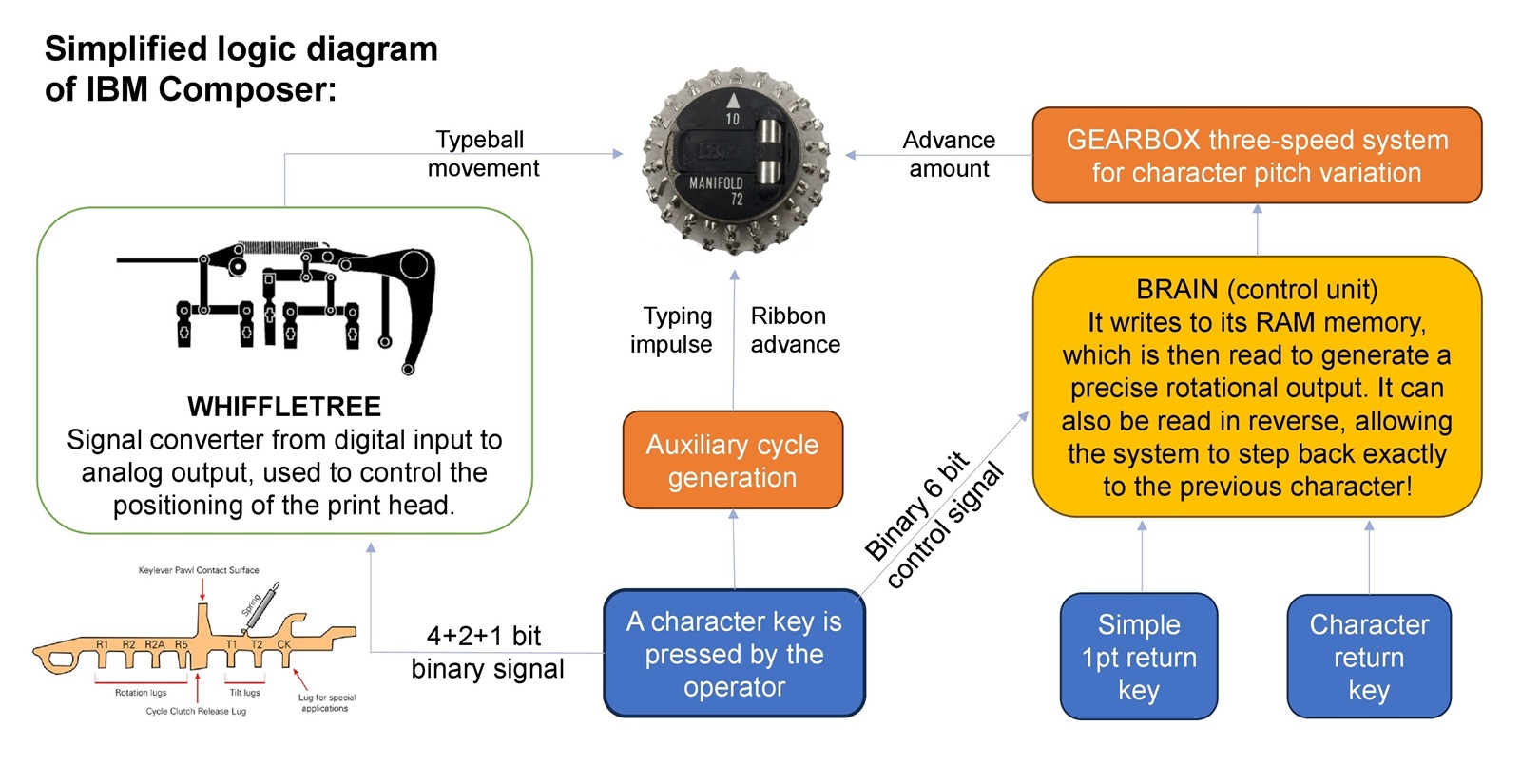
When a key is pressed, a 6-bit binary signal is generated and transmitted to the “mechanical brain.” In theory, this would allow for 2⁶ = 64 possible combinations.

However, only 7 are actually used:
100000 → 3 units (l, i, j, etc.)
010000 → 4 units (r, s, t, etc.)
001000 → 5 units (e, a, g, etc.)
000100 → 6 units (q, n, o, etc.)
000010 → 7 units (T, L, C, etc.)
000001 → 8 units (w, A, F, N, etc.)
000000 → 9 units (m, M, Q, W, etc.)
Note how pressing the same key can generate a different binary code depending on whether an uppercase or lowercase letter is requested. For example, a lowercase “a” sends a signal to advance by 5 units, while an uppercase “A” advances by as many as 8 units. This variation in the signal is generated by a series of comb-like mechanisms beneath the keyboard, which shift from the normal position to the “uppercase” position whenever the operator selects a capital letter.

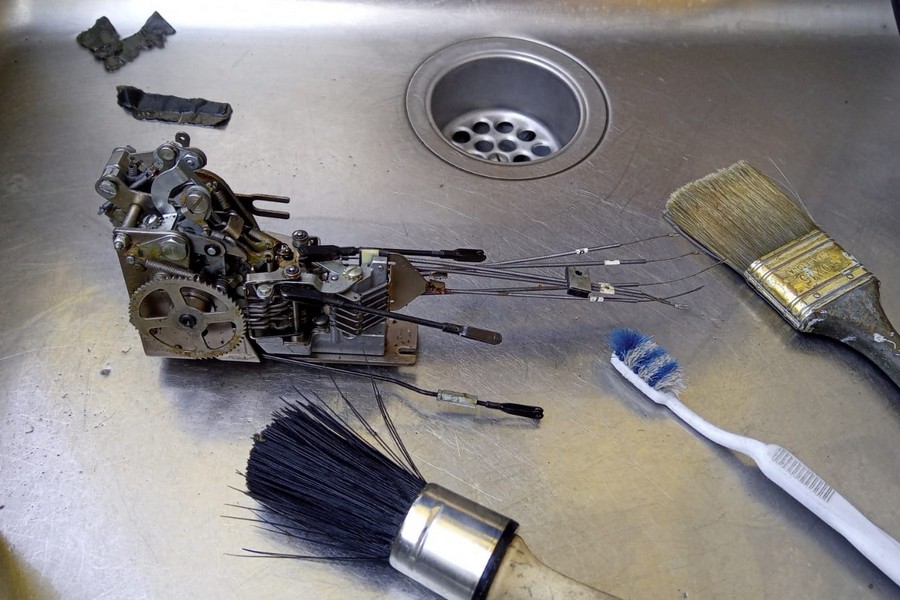
The mechanical memory on which the signal is recorded consists of 60 basic units (pins). After the writing operation described in the previous slide, the escapement mechanism is activated, causing the shaft to rotate by as many sixtieths of a full turn as the required spacing units. The process can also be reversed: through a special cycle, the memory can be read backward, allowing the operator to move back in the event of a typing error to the previously typed character. By moving back several characters, it is even possible to erase an entire word (provided it is not too long…). This was something truly unimaginable on any other proportional typewriter produced up to that time! In the images shown below, you can see the “brain” (control unit) disassembled during cleaning with a heptane-based solvent, as well as how it appears once mounted inside the machine.


Suppose the lowercase letter “a” has been pressed. The binary signal sent to the brain is 001000, corresponding to 5 units. The fifth pin is then extracted from its resting position, and the escapement mechanism is activated. The drum passes the pin on which it was previously resting and rotates until it stops at the extracted pin, generating 5/60 of a full rotation (30°).

This rotational impulse—30° in the case of the letter “a”—passes through the three-ratio gearbox, which allows typing with different pitch settings. Let's look at the image: the three transfer gears have 75 teeth, while the change gears have 30, 35, and 40 teeth. The three transmission ratios are easily calculated: 0.4 – 0.47 – 0.53. The rotational impulse is then transmitted from the gearbox to a precision-ground threaded shaft, which converts the rotary motion into linear movement, advancing the carriage by the required spacing amount.
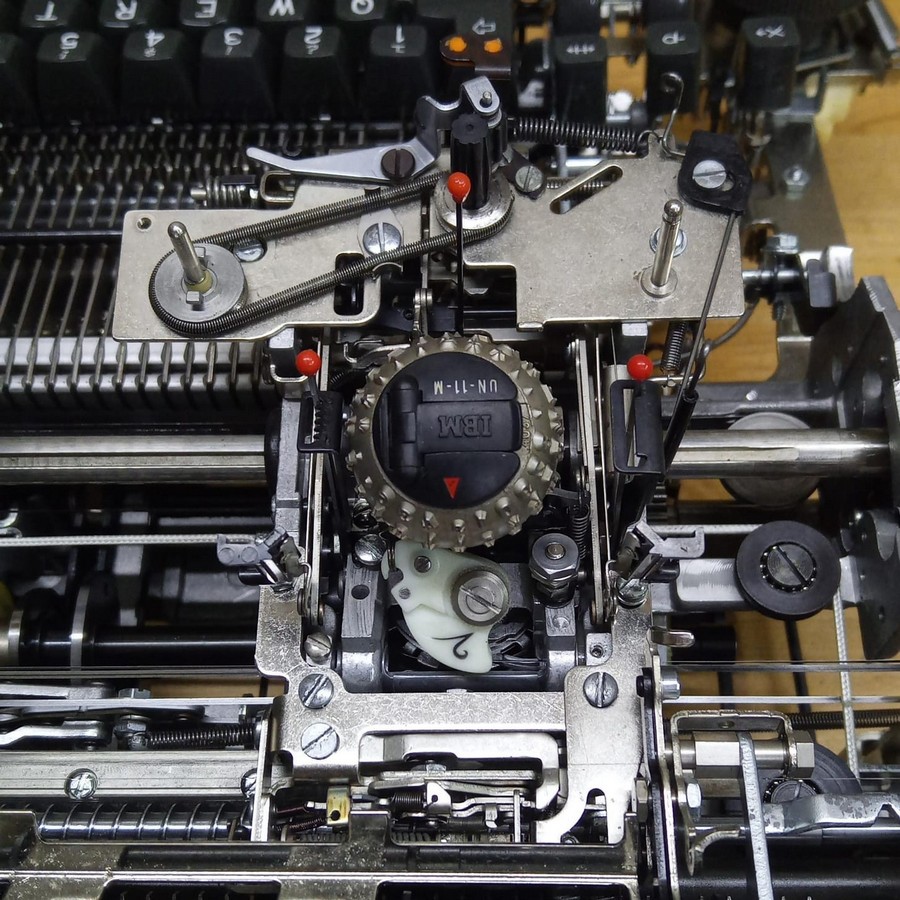
At the same time as the spacing process, the movement and striking action of the typeball takes place. A binary signal is sent to the Whiffletree, where it is processed into an analog movement signal for the two steel tapes that position the typeball, which finally strikes the paper. The extraordinary thing is that this entire process—which involves several hundred mechanical elements moving in perfect synchronization with one another—takes place in only 72 milliseconds!

The Composer is capable of producing perfectly justified text thanks to its front-mounted calculating tube and several auxiliary mechanisms. The process can best be described as semi-automatic, since each line must be typed twice, with the justification knob being set to the value indicated by the calculating tube before the second pass. Let us see how it works step by step.

The operator first sets the right margin at the desired width of the justified column and then types the line, stopping at the appropriate point—naturally before reaching the margin. The "No Print" key may be pressed to prevent the type element from striking the paper while simultaneously disengaging the carbon film ribbon advance, thus avoiding unnecessary ribbon wear. The calculating tube determines how many basic units remain before the right margin. At the same time, having counted the number of spaces in the line, it calculates how much additional spacing must be distributed among them. To simplify the process, it displays a color—representing the integer result of the division—and a number—representing the remainder. These values are then set on the justification control located on the right-hand side of the machine. When the line is typed a second time, the result is perfectly justified text.
A practical example makes the principle much easier to understand. Suppose that a line contains six spaces and that 45 basic units remain before the right margin. The calculating tube performs a very simple calculation, dividing the remaining units by the number of spaces: 45 ÷ 6 = 7, remainder 3. The tube therefore instructs the operator to select the red setting (8-unit spaces) and the number 3.

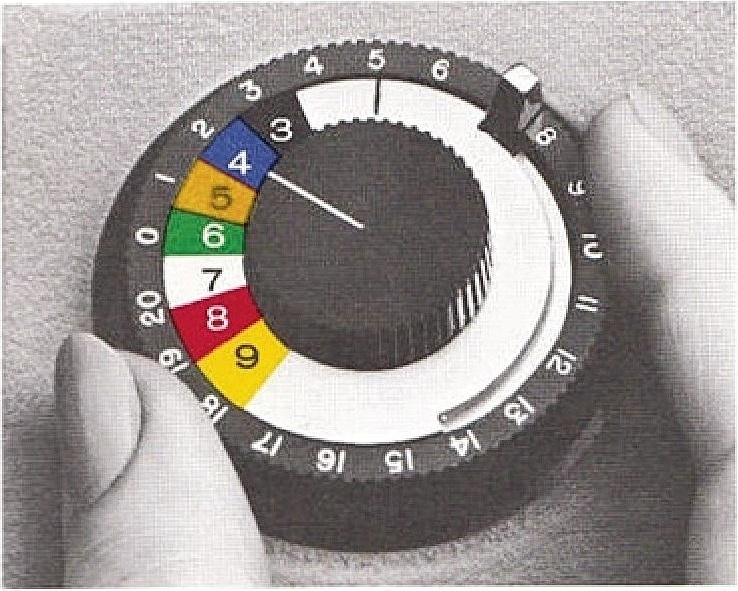
In practice, the first three spaces in the line will be expanded using the red setting, while the mechanism will then automatically switch to the white setting (7-unit spaces) for the remaining three spaces. The result is therefore: 8 × 3 + 7 × 3 = 45 basic units, allowing the line to reach the right margin with perfect justification.


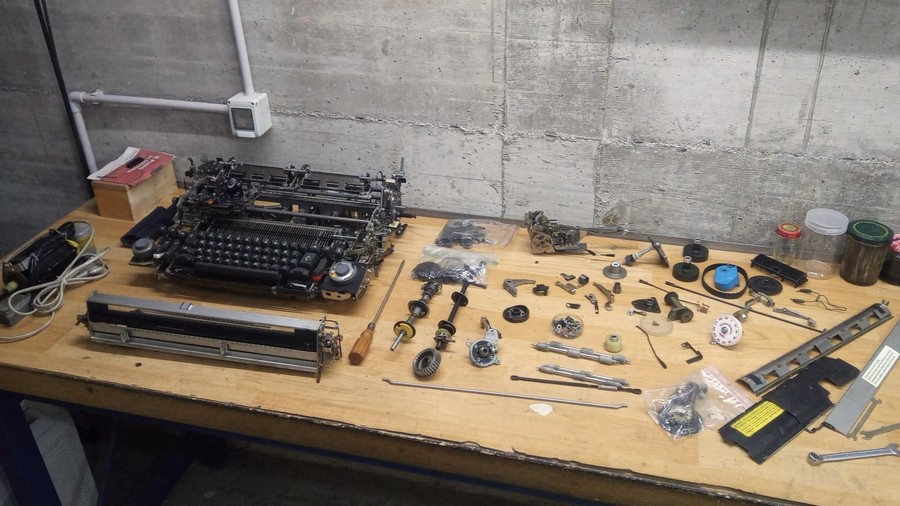
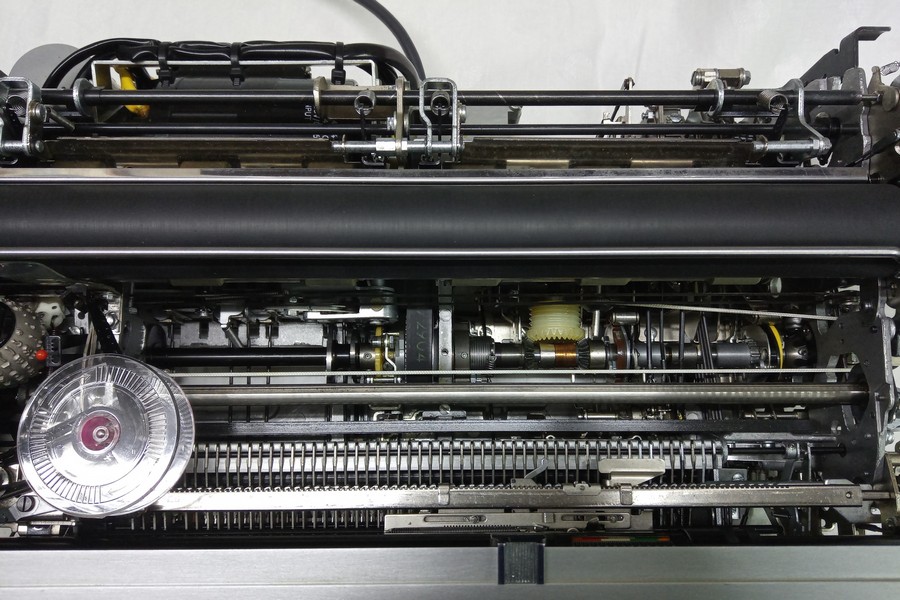
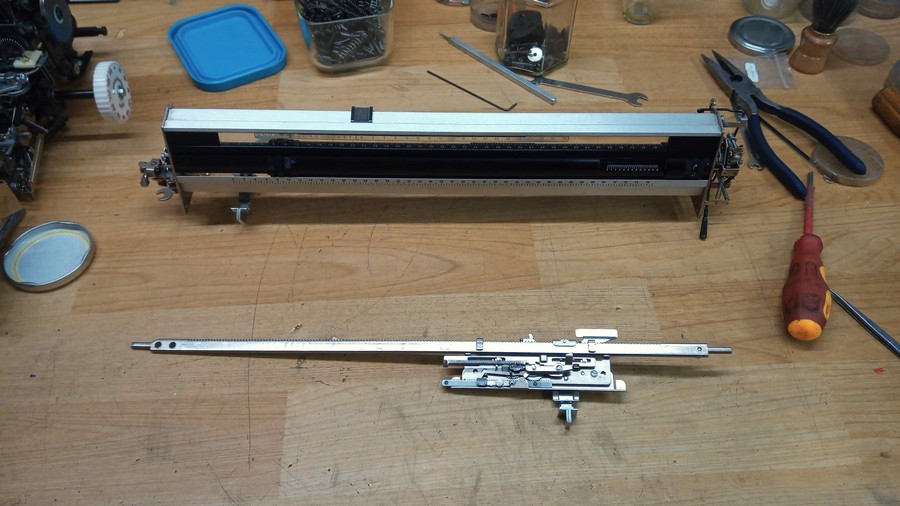
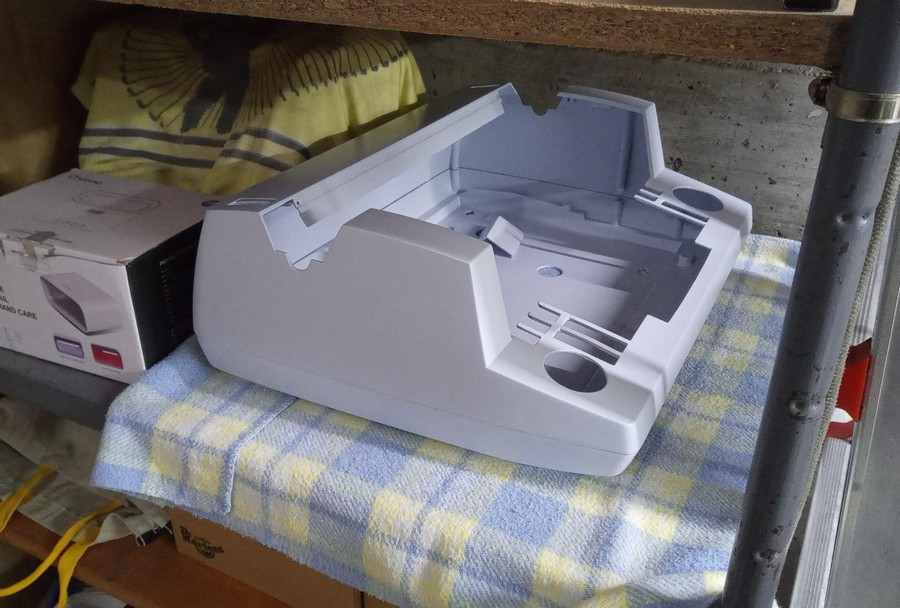
The restoration of the IBM Selectric Composer required the complete disassembly and cleaning of hundreds of mechanical components, many of which had seized after decades of inactivity. Every subsystem—from the escapement and transmission mechanisms to the “mechanical brain” and the Whiffletree assembly—had to be carefully cleaned using ultrasonic treatment and petroleum-based solvents, then dried, lubricated, adjusted, and synchronized to restore the machine’s extraordinary precision. The photographs below document some of the most delicate and demanding stages of this work.


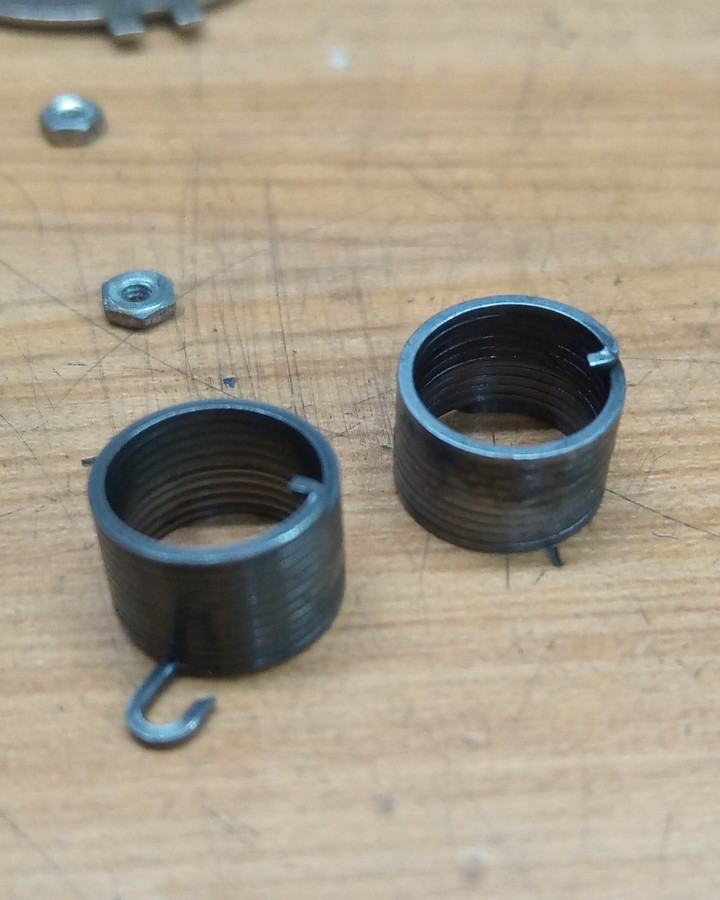


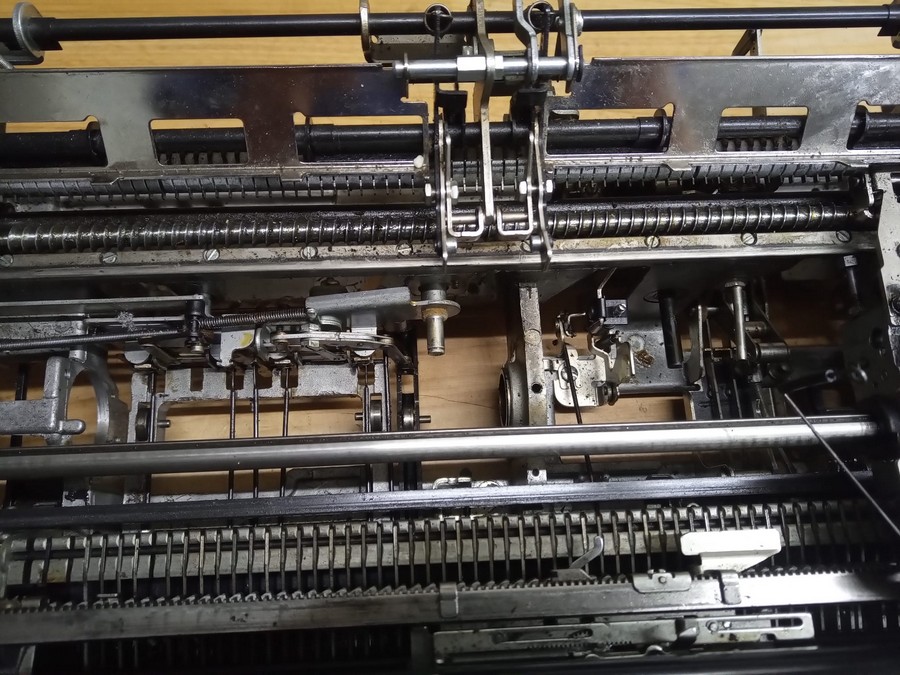


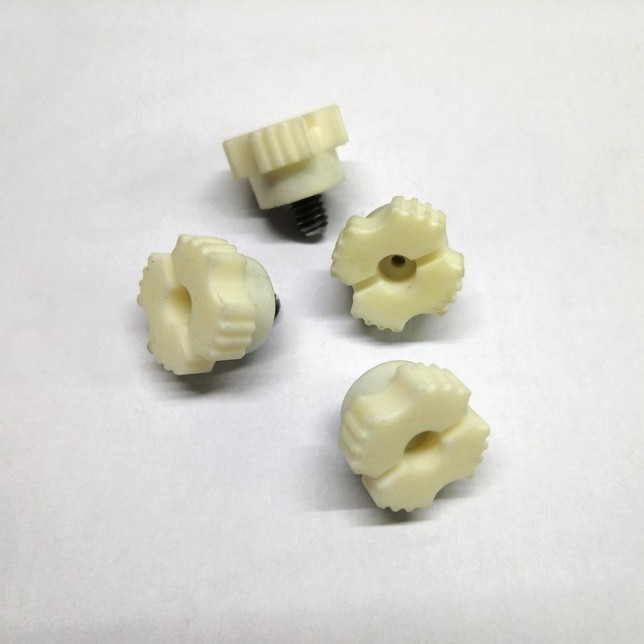












At the end of the restoration, the typewriter undergoes a complete functional test. A final test certificate—typed on the machine itself, signed, and stamped—is issued as proof of successful inspection and completion of the service.


