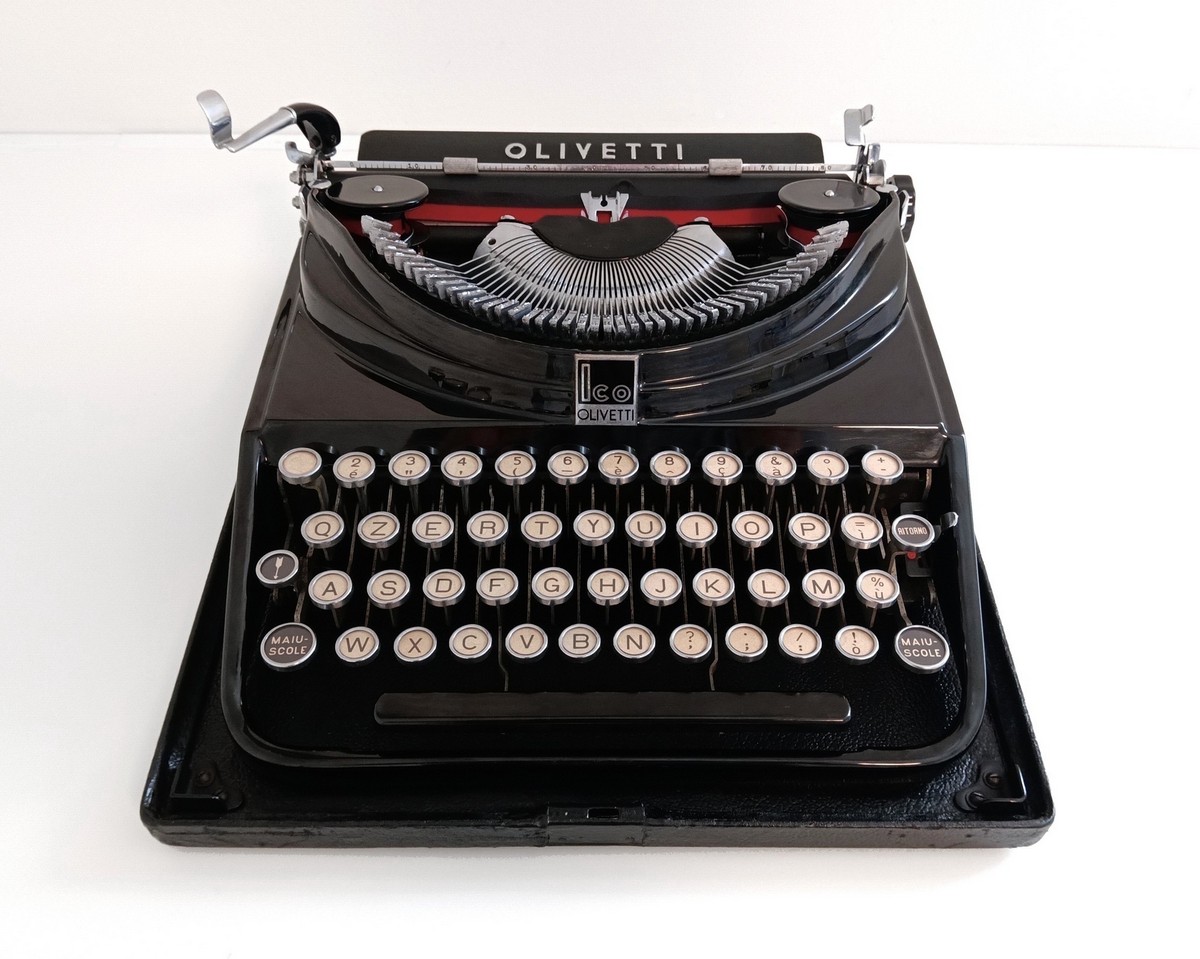

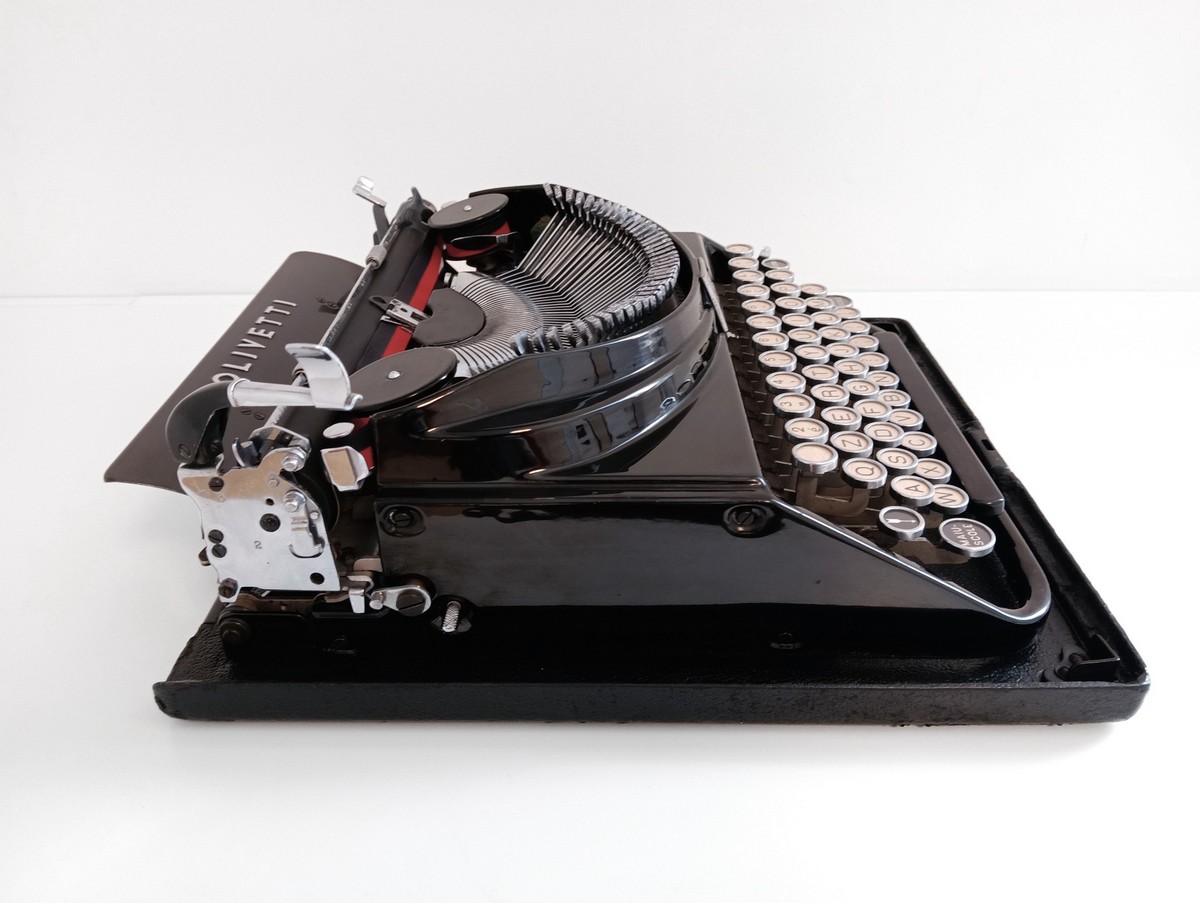





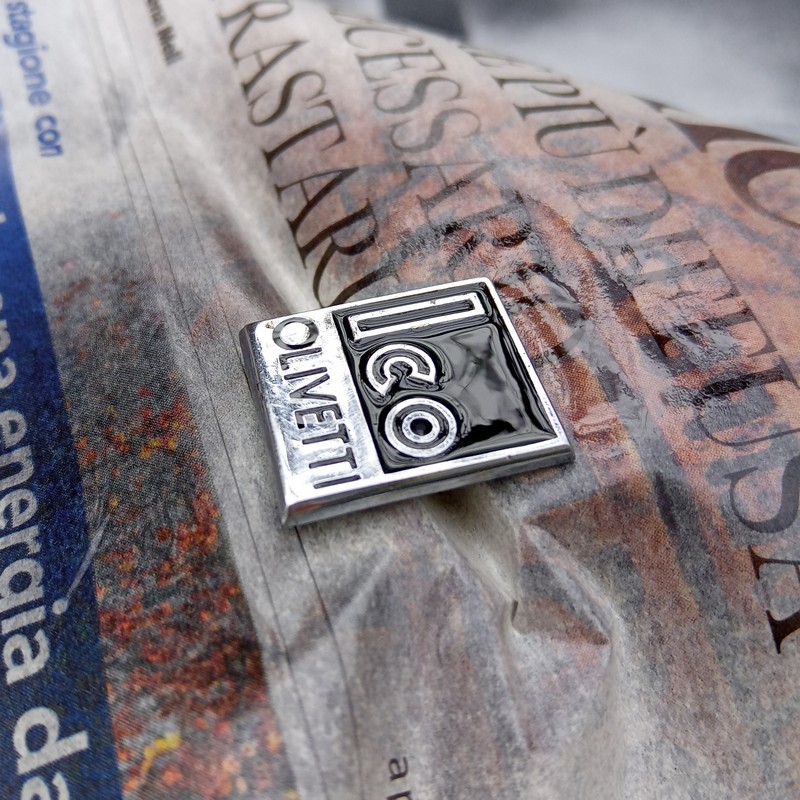
The Olivetti MP1, an abbreviation of Macchina Portatile 1 (“Portable Typewriter 1”), was the first portable typewriter marketed by Olivetti. Its correct name is Olivetti MP1, not “La ICO”, as it is often mistakenly called because of the prominent badge on the front bearing the acronym ICO, which stands for Ingegner Camillo Olivetti (“Engineer Camillo Olivetti”). The same emblem also appears as a gold decal on the Olivetti M1, M20 and M40/1.
 But why is the model designation clearly shown on the M20 and M40, while neither the M1 nor the MP1 actually bears its model name? The reason is simple and purely commercial. What customer would have trusted the very first typewriter made by a relatively unknown manufacturer when well-established American brands, already proven over many years, dominated the market? Only a rather short-sighted entrepreneur would have prominently written “Model No. 1” on his first typewriter, as such a designation could easily create uncertainty in the mind of a potential buyer. It was therefore better to leave the model number off altogether – or even to start with “Model No. 7”, despite Models 1 through 6 never having existed! This was not the case with Olivetti, but some typewriter manufacturers did indeed adopt this strategy. Adler, for example, began its typewriter production in 1898 with the Model No. 7. In this way, customers felt more confident, believing they were purchasing a machine whose design had already been thoroughly tried and tested.
The Olivetti MP1 is one of the few and unusual typewriters to feature a mechanism with toothed typebars: the typebar is not actuated by a simple lever, but by means of teeth cut directly into the typebar itself, close to its pivot. Among the earlier machines employing similar systems were the Mercedes Standard 1 and the Remington Portable 1, 2 and 3. Compared with these, however, the MP1 has a distinctive feature: both the toothed actuating bars and the toothed typebars were carefully designed to be mounted on a single precision-machined cast-iron block. This arrangement made it possible to achieve extremely precise mating tolerances and contributed to giving the MP1 its famously light touch — "as a butterfly".

The touch of an MP1 is something quite unique: soft, direct and extremely fast. With a new platen, its sound is particularly pleasant; the mechanism is solid and precise, also thanks to the rigid construction of the entire key action, as described above. I would also like to stress that this is one of those models that benefits most from a professional restoration: therefore, do not judge the true qualities of an MP1 by the way an unrestored example feels, as it is simply not representative of what the machine is capable of.
As one of my dear German clients once wrote to me, in Italian, in a letter:
“If I had to choose one typewriter to stay with me for the rest of my life, it would be the MP1. It has everything: design, portability, responsiveness to the lightest touch, and one of the most elegant typefaces, the ‘Simplicitas’.”
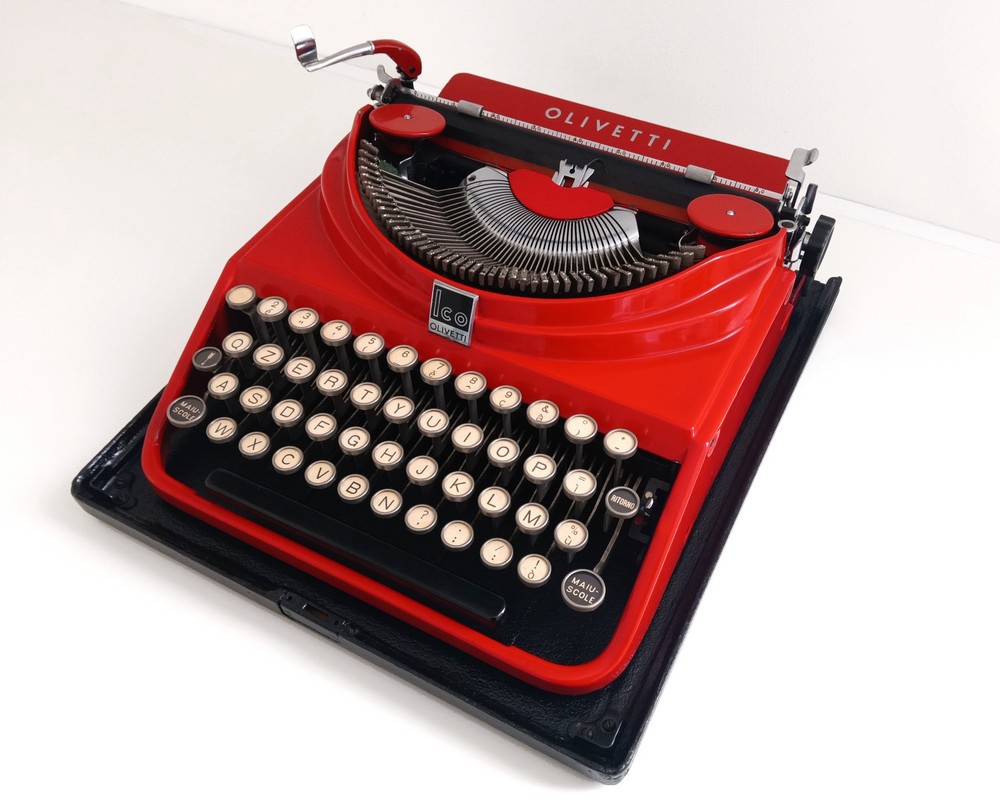


This is a particularly desirable version thanks to an excellent combination of features: it has the same red colour as the machine shown in the famous 1934 advertising poster by Xanti Schawinsky and is fitted with the elegant and highly sought-after “Italico” typeface, with a 2.6 mm pitch (No. 64 AR), produced by the German type foundry Alfred Ransmayer & Albert Rodrian.
The condition of the original paint on this example can be described as very good — a real stroke of luck. Unfortunately, the enamel finish on these beautiful Olivetti machines tends to lift and flake, sometimes quite extensively, due to a combination of factors such as the lack of an adhesion primer, the smoothness of the underlying metal and the conditions in which the machine has been stored.


If the original paint on an Olivetti MP1 needs to be retouched, the exact shade must first be recreated through careful trial mixing and then restored almost “surgically”, only where necessary, preserving as much of the original enamel as possible wherever it remains in good condition. As with most typewriters that are not black, the original colour does not correspond to any standard shade and must therefore be reproduced by testing and progressively adjusting the paint mixture, adding or reducing the basic colours until the correct tone is achieved.
It is important to note that the original shade is not a bright red, but a subdued, muted red. Unfortunately, most red MP1s seen on the market are fakes; moreover — and perhaps fortunately, since this makes them easier to identify — they are repainted in obviously incorrect shades, typically using RAL 3003 Ruby Red spray paint. So, if you are considering buying an Olivetti MP1, be very careful: avoid unqualified sellers and learn to recognise the original colour shades. With a little experience, you will soon be able to distinguish an original finish from a fake one.
A complete restoration of a typewriter begins with the disassembly of the machine, followed by a thorough cleaning of all mechanical components, first using an ultrasonic bath and then rinse using a petroleum-based solvent.
Once cleaned, every component is carefully dried and reassembled, and then the internal mechanism is precisely lubricated to guarantee optimal performance. The mainspring is also dismantled, cleaned, and reassembled with fresh grease, ensuring consistent tension and smooth carriage movement.
The machine then undergoes a comprehensive adjustment process, including fine-tuning of the kinematics, ribbon lift, and upper/lower case alignment. Components subject to natural wear, such as the ink ribbon, rubber grommets, carriage drawcord, and any weakened springs, are replaced with new parts.


Against stubborn dirt dried after fifty or more years of neglect, the classic combination of kerosene and a brush would achieve very little. I am referring specifically to dried correction fluid, eraser residue —sometimes melted by the heat of an attic—, hardened grease, deposits of sebum mixed with dead skin, and so on. The ultrasonic cleaning tank I use in my restorations was built by a specialized company and is specifically designed and custom-made for cleaning typewriters. After ultrasonic cleaning, all components are thoroughly rinsed with kerosene and a brush to remove any microscopic traces of water that may remain in the mechanisms.


How does it work? The phenomenon involved is cavitation. The powerful waves generated by the sonotrodes are transmitted into the water, creating microbubbles at extremely high pressure that implode upon contact with the object. Using a simple solution of water and soap, a combined action is achieved: a physical high-frequency “micro-brushing” effect together with the degreasing action of the detergent dissolved in the bath. The result is excellent, with a low environmental impact when biodegradable soaps are used.

Olivetti mp1 mechanical body after disassembly and ultrasonic cleaning.
To restore an Olivetti mp1 typewriter to perfect working condition, it is essential to rebuild the various rubber components, which over time tend to harden and eventually crumble completely. Feet, main platen, and both lower and front paper rollers—all must be renewed. Everything is made possible thanks to experience and specialized equipment. For more information, please visit this page.

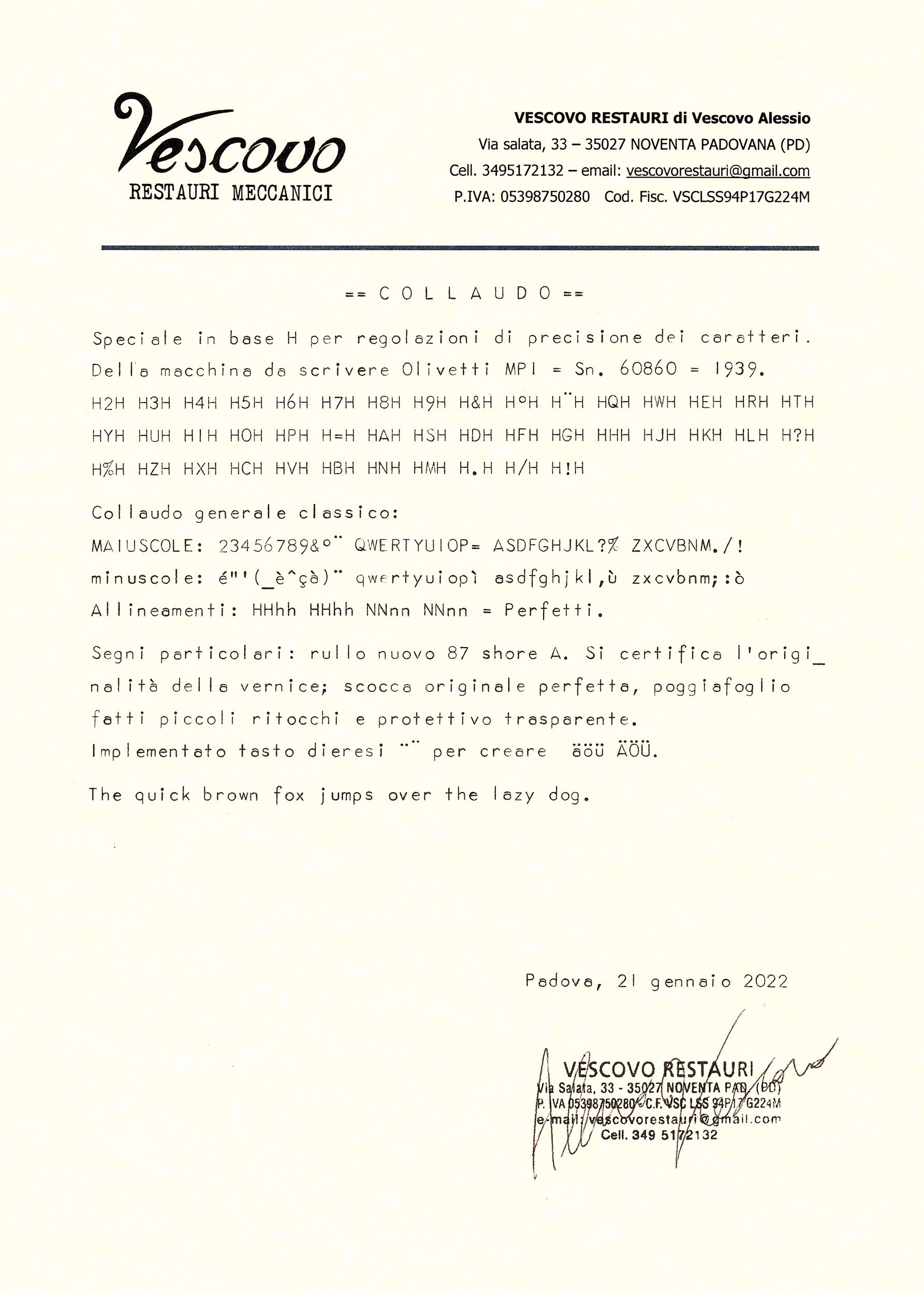
At the end of the restoration, the typewriter undergoes a complete functional test. A final test certificate—typed on the machine itself, signed, and stamped—is issued as proof of successful inspection and completion of the service.

At the end of the restoration, the typewriter undergoes a complete functional test. A final test certificate—typed on the machine itself, signed, and stamped—is issued as proof of successful inspection and completion of the service.