
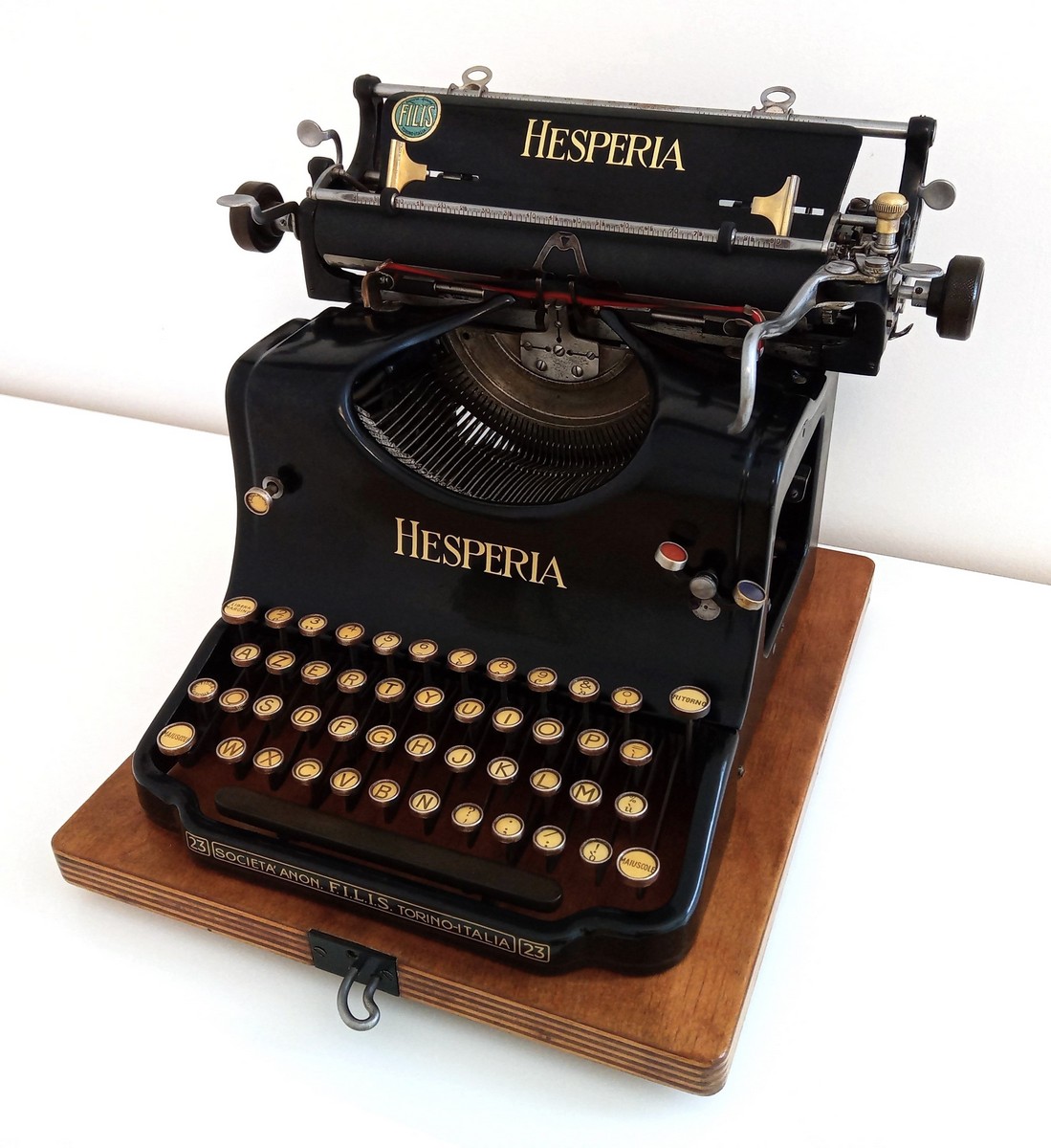





The Hesperia typewriter is an Italian product manufactured by F.I.L.I.S., “Fabbrica Italiana Lavorazioni In Serie”. It is certainly a very rare machine, and by examining the serial numbers of the few surviving examples, it has been possible to estimate the total production quantity. The serial number consists of three digits followed by a letter; for example, the specimen featured in this article is 623A. Initially, I assumed that the numbering was sequential from 001 to 999 for letter A, then 001B and so on. In reality, however, a specimen with a serial number above one thousand has been found (1310A), so the hypothesis I now consider more realistic is that “A” refers to model 23, while “B” refers to the subsequent model 30, which is documented in a commercial brochure.
This theory could be confirmed by checking whether machines marked with “B” display the number 30 on the sides of the keyboard frame instead of 23, and it would also be important to identify the differences between these two models, which appear identical at first glance. In any case, most of the known examples bear the letter A, with only a few B specimens paired with low serial numbers, suggesting a total production of around two thousand units.
 The design is a mix of innovative and personal ideas by engineer Alberto Levi, combined with concepts taken from other models whose patents had already expired. For example, the gear system used to set line spacing is an idea borrowed from the American Smith Premier. The typebar mechanism is highly original; it may have been developed independently or significantly improved from that of the Royal 10 (1914). It is interesting to note a similarity with the Olivetti M40 (1930). One may wonder whether Olivetti engineers may have studied a Hesperia typewriter to draw inspiration for what, in my personal opinion, was the finest typewriter mechanism designed before the Second World War.

The specimen was in poor condition before restoration; however, it was incredibly complete and original, and despite the oxidation it still showed important signs of life, confirming the remarkable solidity of the machine. None of the small details that are often lost were missing: I am referring to the ribbon spools, screws, ribbon terminals, and so on. Even the rubber parts were all present, although they were clearly beyond recovery, having become hardened and cracked.
The wooden base — made of beech plywood, like its distinctive metal locking hardware — was complete but in need of restoration. The paintwork was very dirty but otherwise in almost impeccable condition, and for this reason it was decided to reconstruct the decals as well, restoring a certain brilliance to the machine.


To restore a Hesperia typewriter to perfect working condition, it is essential to rebuild the various rubber components, which over time tend to harden and eventually crumble completely. Feet, main platen, and both lower and front paper rollers—all must be renewed. Everything is made possible thanks to experience and specialized equipment. For more information, please visit this page.


