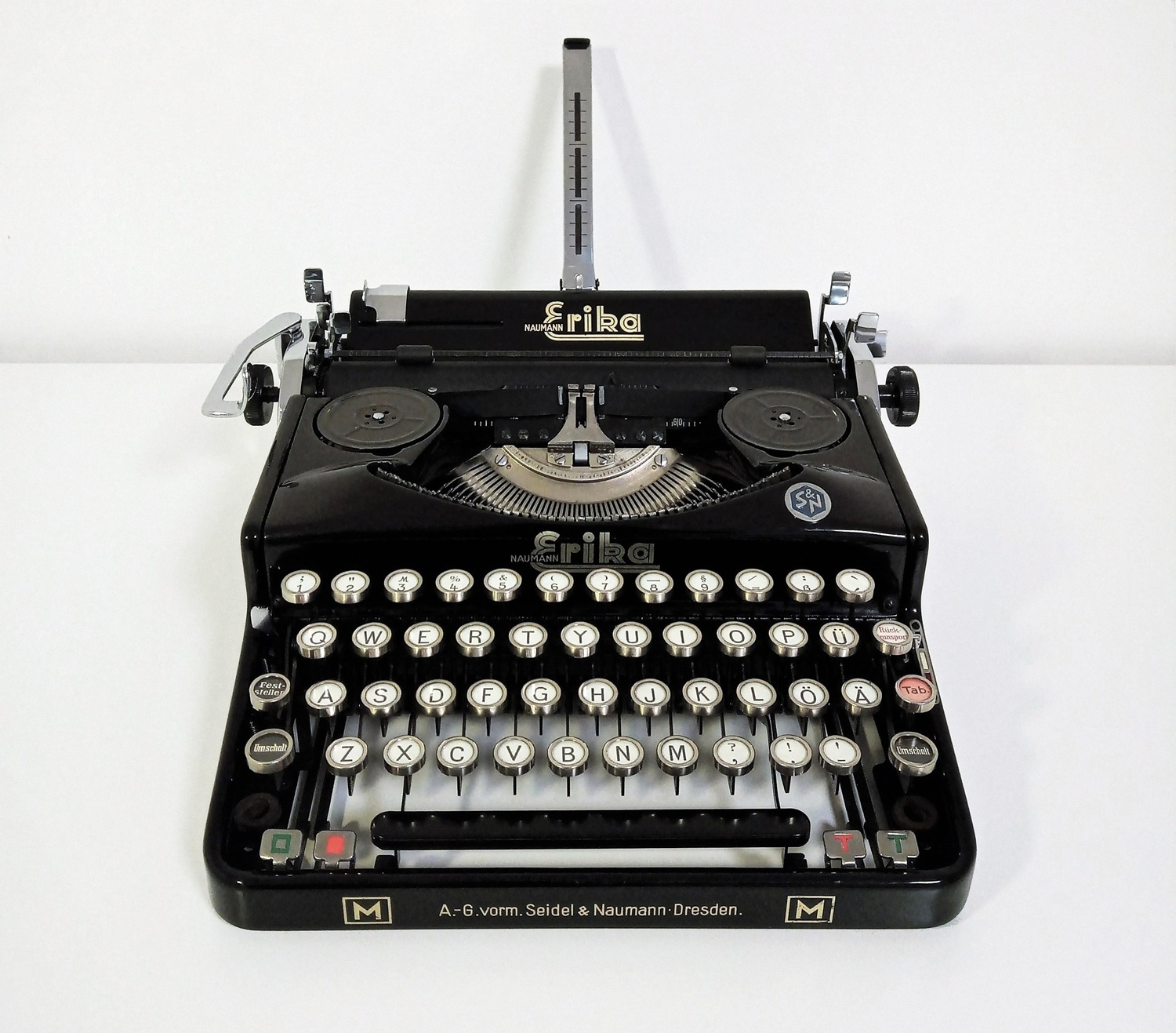

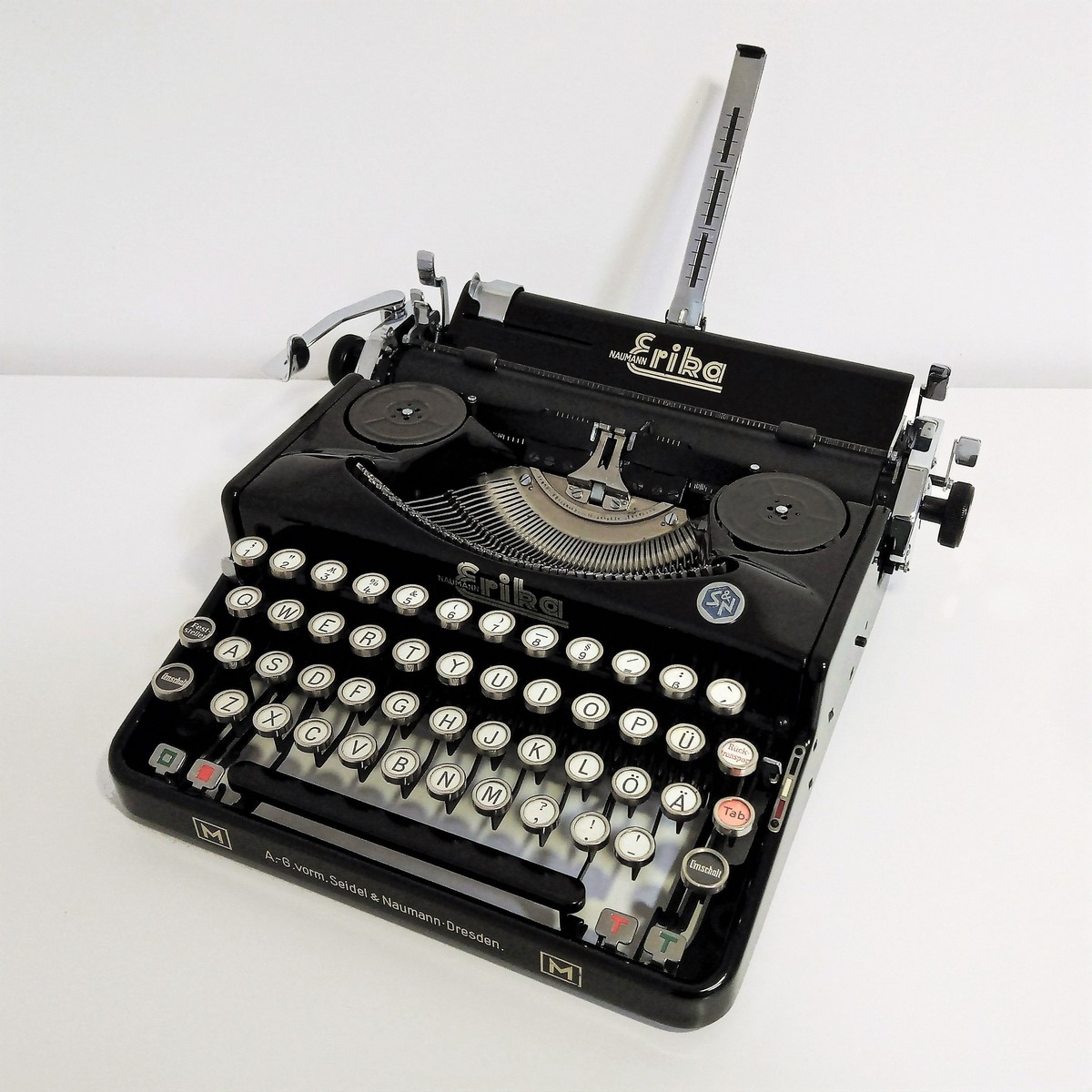





A bold engineering design, high-quality materials, and precision manufacturing: these are the characteristics that give life to the Erika M. It is a German portable typewriter considered by many writers to be one of the best typewriters of all time.
Portable in size, yes, but not in weight; when you pick it up, you cannot help but wonder how such a small machine can be so heavy. It is extremely solid, as many of its precision components are made from cast-iron castings. The mechanism is highly refined: its main characteristic is that the keys move in a motion perpendicular to the typing surface, rather than following a circular arc as most typewriters do. But there are other complexities—fortunately in a positive sense—almost as if we were dealing with a mechanical watch.

The margin adjustment system uses square green and square red buttons located at the lower left; the tabulator mechanism uses red “T” and green “T” buttons located at the lower right. All of this makes it quite complex to restore. Some parts seem almost intentionally designed to complicate maintenance for someone like me, but the effort is rewarded during testing, resulting in an excellent machine.


The Erika Model M featured in this article was restored for an Irish writer, who told me he had been searching for a QWERTY layout version for a long time without success. I replied: “no problem, I can build the keyboard you need!”
It is worth noting that this model was produced between 1935 and 1949, meaning its industrial production largely coincided with the historical period of Nazi Germany. The very few Erika M machines equipped with an English keyboard were produced in the short period following the end of the war; otherwise, they are modified versions of German keyboards, such as the one presented here.

To achieve a QWERTY layout, the Z–W and M–? type slugs were carefully desoldered, swapped, and re-soldered using tin and flux. After soldering, precise type alignment is essential for perfect printing, requiring the use of specialized type-adjusting pliers—rare original tools that are indispensable for a true restorer.
A piece of family craftsmanship: my father first worked as a carpenter, and later—until retirement—as a leather cutter in a shoe factory. My mother used to sew shoe components at home on a piecework basis, up until the 1990s, when the footwear industry of the Riviera del Brenta faced widespread closures and many companies relocated abroad. The material used is antiqued leather, hand-cut with a traditional leather knife. It was then machine-stitched and riveted onto the case. The result is excellent and perfectly in keeping with the age and character of the suitcase.


