





The Emerson No. 3 is a beautiful American typewriter manufactured between 1909 and 1914 in the state of Illinois. Like many other typewriters, the No. 3 had no No. 1 or No. 2 predecessors. Production began in Momence before later moving to Woodstock, where manufacturing continued until the company ceased operations.
This remarkable machine features three characters assigned to each key and an original mechanical design with typebars arranged in two separate banks, one on the right one on the left. Lowercase characters are positioned in the center of each typeslug, uppercase letters below, and numbers and symbols above. The distinctive shape of the typebar covers gives the machine an unmistakable appearance, often compared to an unusual gramophone.
The history of the Emerson Typewriter Company is both fascinating and turbulent, marked by financial difficulties, changes in ownership and ambitious but never fully realized engineering ideas. Readers interested in learning more about the company's story will find an excellent and well-documented article, complete with historical sources, on the OzTypewriter blog.
 Why did it achieve such limited commercial success, becoming such a rare and highly sought-after machine among collectors today? Despite being advertised as "The Greatest Achievement in Typewriter History", the Emerson No. 3 suffered from several practical shortcomings. Its keyboard offered questionable user comfort, while the print quality was generally mediocre, especially for numbers and symbols. Since these characters are located far from the type guide, their typebars tend to vibrate during impression, producing less precise printing (see the typewriter test).
The tabulator system also reveals a rather embarrassing design flaw. Although period advertisements proudly promoted the machine as featuring a tabulator, it was nothing more than a fixed tab stop every ten spaces, with no possibility of programming custom tab positions. More surprisingly, it was not even complete as a fixed ten-space tabulator: if you wanted to tab directly to position "40", you simply couldn't, because the corresponding key does not exist. There was no room left for the mechanism, as the central area of the keyboard was occupied by the ribbon-lift assembly. In its place, the designers installed the "C.C." ribbon-shift button, leaving the machine with an incomplete and rather impractical tabulator layout.

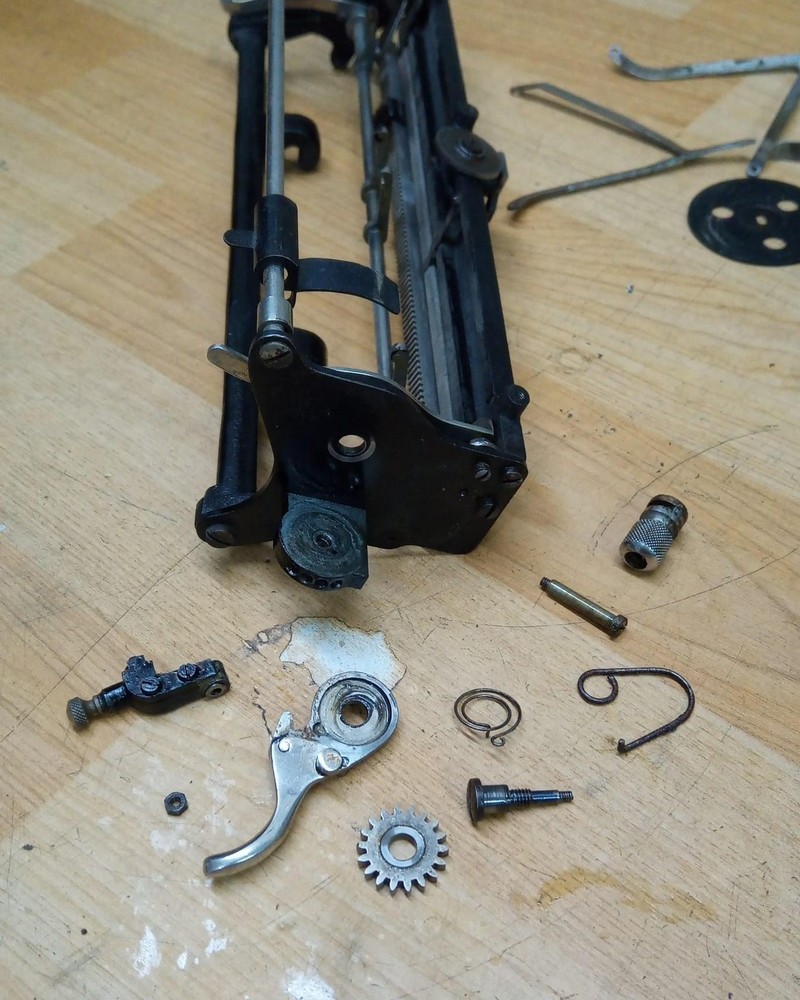
A complete typewriter restoration begins with the full disassembly of the machine, followed by a thorough cleaning of all mechanical components, first in an ultrasonic bath and then with a petroleum-based solvent. Once cleaned, every part is carefully dried, reassembled, and precisely lubricated to ensure smooth operation. The mainspring is also dismantled, cleaned, regreased, and reassembled to provide consistent tension and reliable carriage movement.
The machine then undergoes a comprehensive adjustment process, including fine-tuning of the kinematics, ribbon lift, and upper/lower case alignment. Components subject to natural wear, such as the ink ribbon, rubber grommets, carriage drawcord, and any weakened springs, are replaced with new parts.


In order to return the typewriter to full working condition, it was necessary to reconstruct the various rubber components, which, over time, had hardened and in some cases completely disintegrated. The feet, main platen, lower rollers, and front paper rollers were all renewed using specialized equipment and techniques developed through years of experience. For more information, please visit this page.


At the end of the restoration, the typewriter undergoes a complete functional test. A final test certificate—typed on the machine itself, signed, and stamped—is issued as proof of successful inspection and completion of the service.
